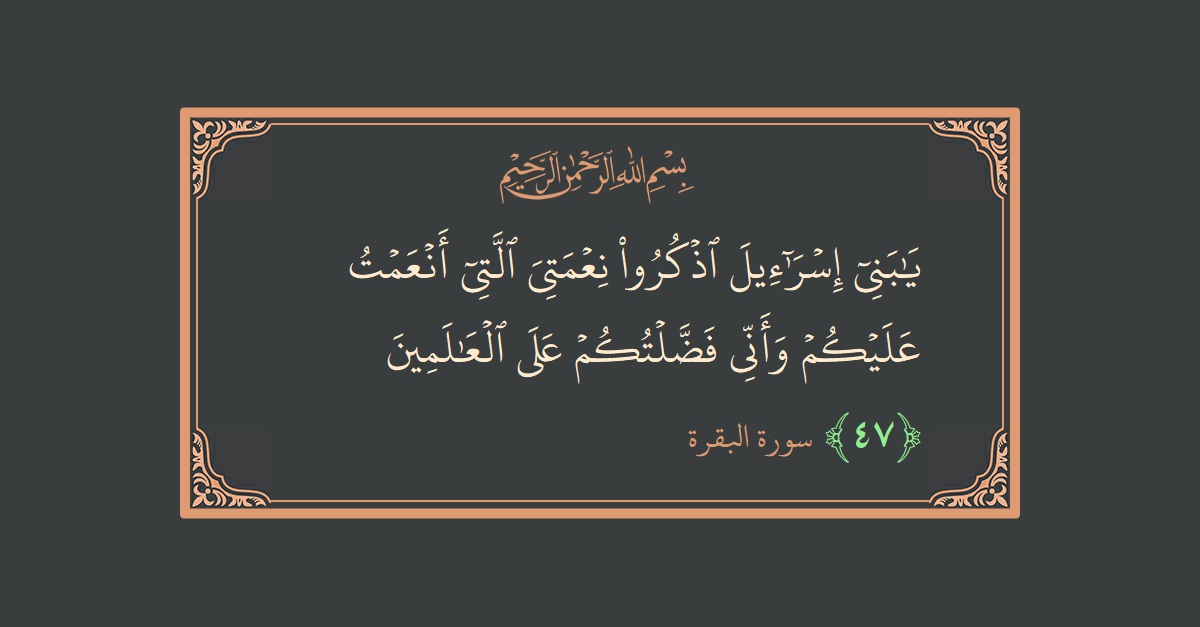
Surah Al-Baqara: Verse 47 - يا بني إسرائيل اذكروا نعمتي... - English
Tafsir of Verse 47, Surah Al-Baqara
English Translation
O Children of Israel, remember My favor that I have bestowed upon you and that I preferred you over the worlds.English Transliteration
Ya banee israeela othkuroo niAAmatiya allatee anAAamtu AAalaykum waannee faddaltukum AAala alAAalameenaTafsir of Verse 47
Verse 47 asks the Israelites to call to their minds the blessing of Allah, so that the recognition of the benefits they have received may induce them to be thankful to Allah and thus to obey Him. The verse is addressed to the Jews contemporaneous with the Holy Prophet ﷺ while the blessing had been received by their forefathers. The point is that when a man receives a special favour, his children and grand children too usually partake of the benefits flowing from it; in this sense, the Jews who are being addressed may be said to have received the blessing themselves.
As for Allah giving preference to the Israelites "over the worlds", the phrase means that they were given preference only in certain matters, or only over a large part of men - for example, over the contemporaries of the earlier Israelites.
The day referred to in verse 48 is the Day of Judgment. As for no one being able to suffice another on that day, the phrase should be understood in the sense of one man paying the dues on behalf of another man. Let us, for example, suppose that a man is found wanting in the performance of obligatory acts of worship like Salah نماز and Sawm صوم (fasting), and another man should suggest that his own prayers and fasts may be transferred to the account of the former in order to make up the deficiency. Such a transaction shall not be possible on that day. Ransom, of course, means the money paid for securing the release of a criminal - this too shall be out of the question. As for intercession (shafa-` ah شفاعہ) not being accepted, the phrase does not totally deny the possibility of intercession on the Day of Judgment; it only means that if a man does not have 'Iman ایمان (faith), no intercession in his favour shall be accepted. For the Holy Qur'an makes it clear in certain other verses that Allah will allow intercession to be made on behalf of some people (53:26, 34:23, 2:55 etc.), and will disallow it in the case of those who do not possess 'Iman ایمان (21:28, 20:109). Since there would be no intercession on behalf of the latter, the question of its being accepted does not simply arise. 'Receiving support', in usual terms, means getting oneself released from a difficult situation with the help of a strong and powerful friend or patron. In short, none of the ways of receiving help possible in this world will be effective in the other world unless one possesses 'Iman ایمان .
A doctrinal point
On the basis of verse 48, the Mu'tazilah and some other groups of a more recent origin have denied the possibility of all intercession in favour of Muslims. But, as we have shown above, the negation of intercession applies only to disbelievers and infidels. (Bayan al-Qur an)
Reminding the Children of Israel that They were preferred above the Other Nations
Allah reminds the Children of Israel of the favors that He granted their fathers and grandfathers, how He showed preference to them by sending them Messengers from among them and revealing Books to them, more so than any of the other previous nations. Similarly, Allah said,
(And We chose them (the Children of Israel) over the `Alamin, (nations) with knowledge.) (44:32) and,
(And (remember) when Musa (Moses) said to his people: "O my people! Remember the favor of Allah to you: when He made Prophets among you, made you kings, honored you above the `Alamin (nations).") (5:20).
Abu Ja`far Ar-Razi reported that Ar-Rabi` bin Anas said that Abu Al-`Aliyah said that Allah's statement,
(and that I preferred you over the `Alamin) means, "The kingship, Messengers and Books that were granted to them, instead of granting such to the other kingdoms that existed during their time, for every period there is a nation." It was also reported that Mujahid, Ar-Rabi` bin Anas, Qatadah and Isma`il bin Abi Khalid said similarly.
The Ummah of Muhammad is Better than the Children of Israel
This is the only way the Ayah can be understood, because this Ummah is better than theirs, as Allah said;
(You are the best of people ever raised up for mankind; you enjoin good and forbid evil, and you believe in Allah. And had the People of the Book (Jews and Christians) believed, it would have been better for them) (3:110).
Also, the Musnad and Sunan Collections of Hadith recorded that Mu`awiyah bin Haydah Al-Qushayri said that the Messenger of Allah said,
(You (Muslims) are the seventieth nation, but you are the best and most honored of them according to Allah.)
There are many Hadiths on this subject, and they will be mentioned when we discuss Allah's statement,
(You are the best of peoples ever raised up for mankind) (3:110).