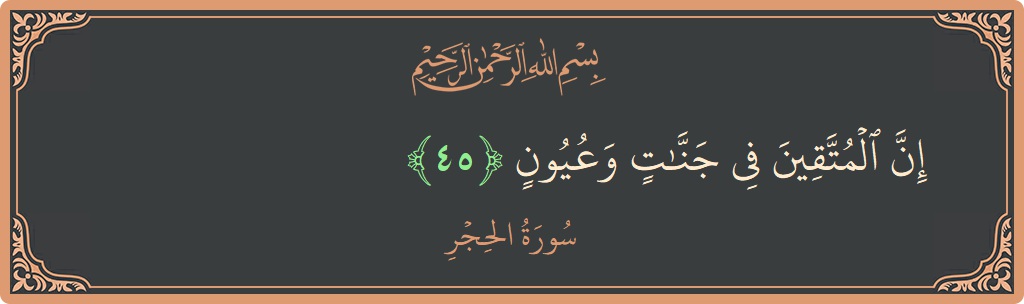
Surah Al-Hijr: Verse 45 - إن المتقين في جنات وعيون... - English
Tafsir of Verse 45, Surah Al-Hijr
English Translation
Indeed, the righteous will be within gardens and springs.English Transliteration
Inna almuttaqeena fee jannatin waAAuyooninTafsir of Verse 45
Commentary
According to Sayyidna ` Abdullah ibn ` Abbas ؓ ، when the people of Jannah will enter Jannah, first of all two streams of water will be presented before them. They will drink water from the first stream and all mutual grudges they had from their life in the mortal world - the effect of which naturally survived right through the end - will be totally washed away. In its place, they all will feel love for each other in their hearts because mutual bickering too is virtually a pain and punishment as such, and Jannah is free of all pain.
As for the report appearing in Sahih Hadith: 'Anyone who nurses the least grudge in his heart against a Muslim will not go to Jannah,' it means the grudge and malice which is rooted in material ends, and is there by one's personal intention and choice, and because of which this person keeps looking for an opportunity to inflict pain or loss on his enemy. Being ill at ease in someone's company as a matter of natural temperament, a human trait beyond one's control, is not included here. Similar is the case of what is based on some Islamic legal ground. It is this kind of grudge which has been referred to in this verse and where it has been said that such grudge and temperamental distaste will be removed from their hearts.
It is about this kind of grudge that Sayyidna ` Ali ؓ said: "I hope that I shall be, along with Talha and Zubayr, among those the dust of mutual anxiety from whose hearts will be removed while entering Jannah." The reference here is to the difference of opinion and resulting conflict which took place between Sayyidna Talha and Sayyidna Zubayr and Sayyidna ` Ali ؓ .
Description of the People of Paradise
Since Allah mentioned the condition of the people of Hell, He followed that by mentioning the people of Paradise. He tells us that they will dwell in Gardens and water springs.
(Enter it in peace) meaning free of all problems.
(and security.) meaning free from all fear and concern. They will not have any fear of expulsion, nor will they fear that their condition will be disrupted or end.
(And We shall remove any deep feeling of bitterness from their breasts. (So they will be like) brothers facing each other on thrones.) Al-Qasim narrated that Abu Umamah said: "The people of Paradise will enter Paradise with whatever enmity is left in their hearts from this world. Then, when they come together, Allah will remove whatever hatred the world has left in their hearts." Then he recited:
(And We shall remove any deep feeling of bitterness from their breasts.) This is how it was narrated in this report, but Al-Qasim bin `Abdur-Rahman is weak in his reports from Abu Umamah. However, this is in accord with the report in the Sahih where Qatadah says, "Abu Al-Mutawakkil An-Naji told us that Abu Sa`id Al-Khudri told them that the Messenger of Allah said:
(The believers will be removed from the Fire, and they will be detained on a bridge between Paradise and Hell. Then judgment will be passed between them concerning any wrong they have committed in this world against one another, until they are cleansed and purified. Then permission will be given to them to enter Paradise.)"
(No sense of fatigue shall touch them) meaning no harm or hardship, as was reported in the Sahihs:
(Allah commanded me to tell Khadijah the good news of a jeweled palace in Paradise in which there will be no toil and no fatigue.)
(nor shall they (ever) be asked to leave it.) As was reported in the Hadith:
(It will be said, O dwellers of Paradise! You will be healthy and never fall sick; you will live and never die; you will be young and never grow old; you will stay here and never leave.) Allah says:
(Wherein they shall dwell (forever). They will have no desire to be removed from it.) (18:108)
(Declare to My servants, that I am truly the Oft-Forgiving, the Most Merciful. And that My torment is indeed the most painful torment.) meaning, `O Muhammad, tell My servants that I am the source of mercy and I am the source of punishment.' Similar Ayat to this have already been quoted above, which indicate that we must always be in a state between hope (for Allah's mercy) and fear (of His punishment).