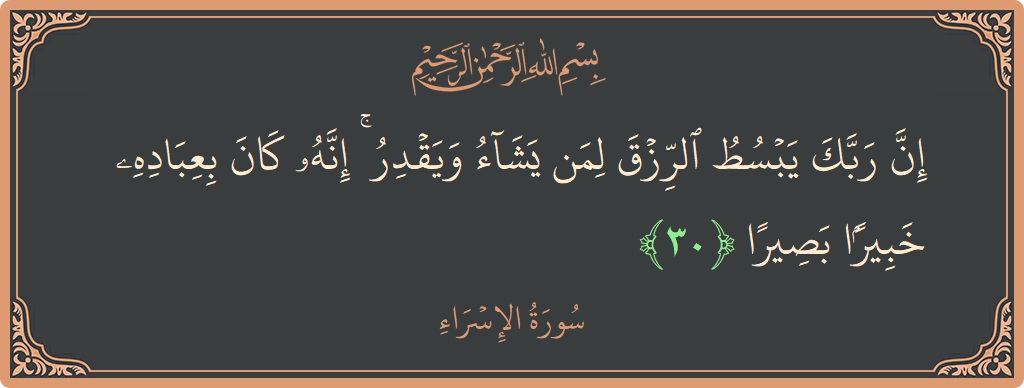
Surah Al-Israa: Verse 30 - إن ربك يبسط الرزق لمن... - English
Tafsir of Verse 30, Surah Al-Israa
English Translation
Indeed, your Lord extends provision for whom He wills and restricts [it]. Indeed He is ever, concerning His servants, Acquainted and Seeing.English Transliteration
Inna rabbaka yabsutu alrrizqa liman yashao wayaqdiru innahu kana biAAibadihi khabeeran baseeranTafsir of Verse 30
Spending in the way of Allah so liberally as would throw one in trouble: The pros and cons of it
The verse, given the outer view, seems to prohibit the kind of spending following which the spender himself ends up becoming poor and needy, a prey of all sorts of hardships and anxieties. Tafsir authority, al-Qurtubi has said that this injunction covers the general condition of Muslims who would, after such spending, find the resulting hardships distressing and the whole thing would make them contrite over past give-outs and grieve about it. The word: مَّحْسُورًا (mahsura: empty-handed - 29) of the Holy Qur'an provides a hint in this direction. (As in Tafsir Mazhari) As for the people of high determination, who would not be emotionally disturbed by hardships that may come later and would still go on fulfilling rights of those who hold such rights, this restriction does not apply to them. This is the reason that it was the customary practice of the Holy Prophet ﷺ that he would not store anything for tomorrow.
What came today was spent out today. And there were occasions when he would remain hungry reaching the outer limits of having to tie a piece of rock against his stomach (to simulate the weight of food). Then there were many among the noble Sahabah who had spent their entire wealth and property in the way of Allah during the blessed period of the Holy Prophet ﷺ who did not categorically prohibit it nor did he blame them for it. This tells us that the prohibition contained in this verse is for those who cannot brave the hardships of poverty and hunger and they would start to rue after spending that they would have been better off if they had not spent in the way of Allah. If so, this attitude would nullify the good they had done in the past. Hence, the prohibition.
Poorly managed spending is prohibited
And the main thing in the verse is that it prohibits spending haphazardly in the sense that one would ignore what may happen in the near future and spend on the spot. The result is that comes tomorrow, other needy people show up or one is required to take care of a major religious exigency and he would, then, be in no position to help out. (Qurtubi) Or, he may be rendered equally incapable of fulfilling the rights of his family, something he is duty-bound to fulfill. (Mazhari) Explaining the words: مَلُومًا مَّحْسُورًا (reproached, empty-handed - 29), Tafsir Mazhari says that the first word: مَلُوم (malum) relates to the first condition, that is, miserliness - meaning if he were to hold back on giving out of miserliness, people would reproach him.' And the word: مَّحْسُورًا (mahsura) relates to some condition other than this - meaning that one should not exaggerate in spending to the extent that he himself becomes a pauper. If so, he will turn empty-handed, defeated and rueful.