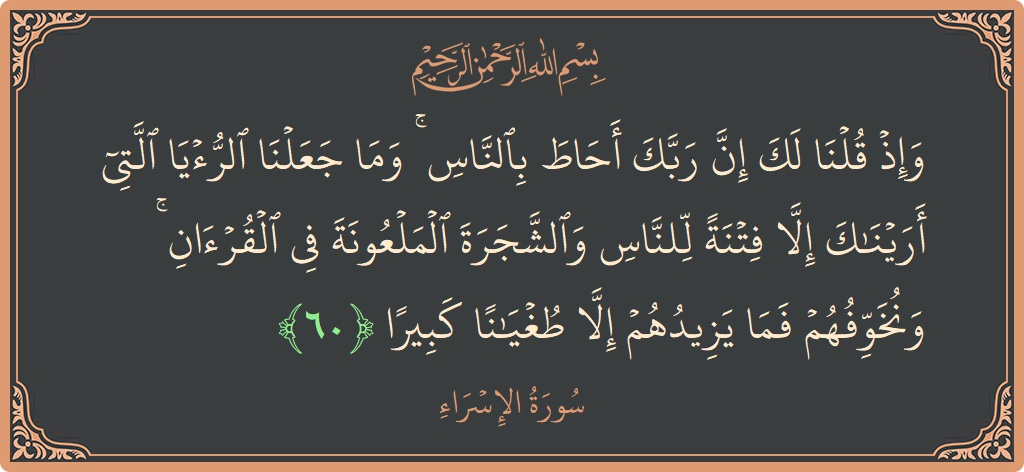
Surah Al-Israa: Verse 60 - وإذ قلنا لك إن ربك... - English
Tafsir of Verse 60, Surah Al-Israa
English Translation
And [remember, O Muhammad], when We told you, "Indeed, your Lord has encompassed the people." And We did not make the sight which We showed you except as a trial for the people, as was the accursed tree [mentioned] in the Qur\'an. And We threaten them, but it increases them not except in great transgression.English Transliteration
Waith qulna laka inna rabbaka ahata bialnnasi wama jaAAalna alrruya allatee araynaka illa fitnatan lilnnasi waalshshajarata almalAAoonata fee alqurani wanukhawwifuhum fama yazeeduhum illa tughyanan kabeeranTafsir of Verse 60
Commentary
The word fitnah' (فِتنَہ) appearing in verse 60: وَمَا جَعَلْنَا الرُّؤْيَا الَّتِي أَرَيْنَاكَ إِلَّا فِتْنَةً لِّلنَّاسِ (And We showed you the scene [ in the Night of Ascent - al-Mi` raj ] only to make it a test for the people) is used in the Arabic language to convey many different meanings. It could mean falling into error and going astray, or trial or test or some disorder or upheaval as well. At this place, the probability of all these meanings exists. Early Tafsir authorities - Sayyidah ` A'ishah, Sayyidna Mu` awiyah, Hasan, Mujahid and others - have taken fitnah' as carrying the last sense given above. They have said that this fitnah' was that of apostasy (Irtidad) which relates to the time when the Holy Prophet ﷺ told people about Mi` raj, how he went on his nocturnal journey to Baitul-Maqdis, to the heavens from there and his return to Makkah al-Mukarramah before dawn. There were many neo-Muslims who had yet to become staunch in their faith fell into the error of belying his statement and turned apostates. (Qurtubi)
It also stands proved from this event that the word رُّؤْيَا (ru'ya) is though also used in the Arabic language in the sense of dream but, at this place, what is being recounted is no matter of some dream. Had that been the case, there was no reason why people would become apostates. Dreams are dreams. Everyone can see such dreams. In fact, the purpose of employing the word: رُّؤْيَا (ru'ya) at this place is to show that the marvel was witnessed while awake. While commenting on this verse, some commentators have interpreted it to be referring to other events too besides the event of Mi` raj. But, they do not apply here as a whole. Therefore, the majority of commentators have declared the event of Mi` raj alone as the relevant subject of this verse. (As described in detail by al-Qurtubi)
Allah has encompassed Mankind and made the Vision of His Prophet a Trial for Them
Allah says to His Messenger , encouraging him to convey the Message and informing him that He is protecting him from the people, that He is able to deal with them and that they are in His grasp and under His domination and control.
(And (remember) when We told you: "Verily, your Lord has encompassed mankind..") Mujahid, `Urwah bin Az-Az-Zubayr, Al-Hasan, Qatadah and others said, "This means, He protected you from them."
(And We made not the vision which We showed you but a trial for mankind,) Al-Bukhari recorded that Ibn `Abbas said:
(And We made not the vision which We showed you but a trial for mankind,) "This is the vision which the Messenger of Allah saw with his own eyes on the night when he was taken on the Night Journey (Al-Isra').
and (likewise) the accursed tree in the Qur a0n. refers to the Tree of Zaqqum." This was also recorded by Ahmad, `Abdur-Razzaq and others. It was also reported by Al-`Awfi from Ibn `Abbas. It was also interpreted as referring to the Night of the Isra' by Mujahid, Sa`id bin Jubayr, Al-Hasan, Masruq, Ibrahim, Qatadah, `Abdur-Rahman bin Zayd and several others. We have already quoted at length a comprehensive collection of Hadith about the Isra' at the beginning of this Surah, praise be to Allah. We have also already stated that some people gave up their Islam after they had been following the truth, because their hearts and minds could not comprehend that, and they denied what their knowledge could not grasp, but Allah caused it to increase and strengthen the faith of others, and so He says:
(but a trial), meaning a test. As for the cursed tree, this is the Tree of Zaqqum. When the Messenger of Allah told them that he had seen Paradise and Hell, and seen the Tree of Zaqqum, they did not believe that, and Abu Jahl, upon whom be the curses of Allah, even said, "Bring us some dates and butter," and he started eating them and saying, "Let us have some Zaqqum, we don't know any other Zaqqum but this." This was narrated by Ibn `Abbas, Masruq, Abu Malik, Al-Hasan Al-Basri and others. Everyone who interpreted the Ayah to refer to the Night of the Isra', also interpreted it to refer to the Tree of Zaqqum.
(We make them afraid) meaning, `We make the disbelievers afraid with Our warnings and punishments and torment.'
(but it only increases them in naught save great disbelief, oppression and disobedience to Allah.) means, it only pushes them further into their disbelief and misguidance, and this is because Allah has forsaken them.