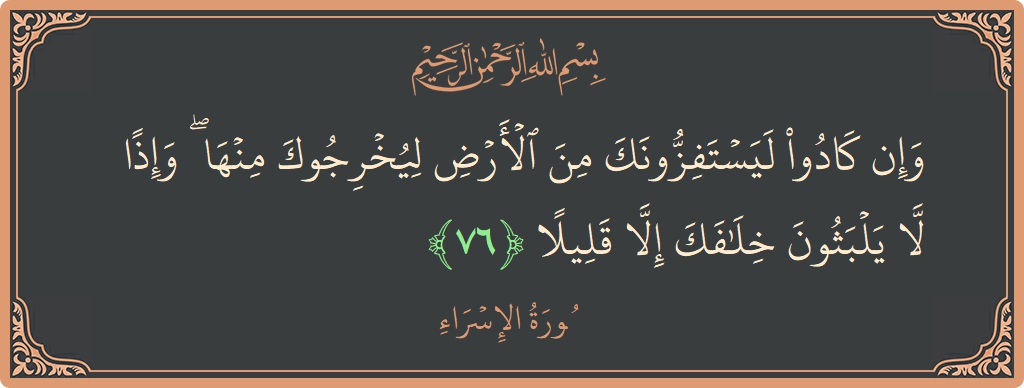
Surah Al-Israa: Verse 76 - وإن كادوا ليستفزونك من الأرض... - English
Tafsir of Verse 76, Surah Al-Israa
English Translation
And indeed, they were about to drive you from the land to evict you therefrom. And then [when they do], they will not remain [there] after you, except for a little.English Transliteration
Wain kadoo layastafizzoonaka mina alardi liyukhrijooka minha waithan la yalbathoona khilafaka illa qaleelanTafsir of Verse 76
Istifzaz in: وَإِن كَادُوا لَيَسْتَفِزُّونَكَ (And they were likely to harass you - 76) literally means to cut off, or tear away from, or to provoke into moving from a place. At this place, the sense is to expel the Holy Prophet ﷺ from his station at Makkah or Madinah. The verse means: Had they done that, their punishment would have been that they themselves would have not been able to live there much longer after you. This is the description of another event. There are two reports about it. One event relates to Madinah al-Tayyibah. The Jews of the city came to the Holy Prophet ﷺ . They told him: 'O Abu a1-Qasim, if you are true in your claim to be a prophet, you should go and live in Syria because the land of Syria is the land of al-Mahshar (the Resurrection) and the land of prophets too.' The Holy Prophet ﷺ was somewhat impressed by what they said and when he traveled to Syria at the time of the battle of Tabuk, the idea of taking up residence in Syria was still on his mind. But, the revelation of the verse: وَإِن كَادُوا لَيَسْتَفِزُّونَكَ (And they were likely to harass you - 76) at that time stopped him from doing so. After presenting this report, Ibn Kathir has, however, declared it to be unsatisfactory.
As an alternate, he points out to another event which transpired in Makkah al-Mukarramah and which, according to him, is the point of reference in this verse for the fact that this Surah was Makki provided a strong coherence for it. As the event goes, once the Quraysh disbelievers intended to expel the Holy Prophet ﷺ from Makkah al-Mukarramah.
Thereupon, Allah Ta’ ala revealed the verse: كَادُوا لَيَسْتَفِزُّونَكَ where the Quraysh disbelievers were warned that in the event they expelled the Holy Prophet ﷺ from Makkah, they too would not be sitting in Makkah in peace any longer. This is the event Ibn Kathir considers to be the weightier choice as the point of reference in the verse. Then, he goes on to explain that this warning of the Holy Qur’ an was seen come true by the disbelievers of Makkah with their own eyes. When the Holy Prophet ﷺ migrated from Makkah al-Mukarramah, they were unable to sit there in peace even for a day. It was within a period of a year and six months that Allah Ta` ala made them assemble on the plains of Badr where seventy of their chiefs were killed and their initial aggressive power was broken. Then came the final outcome of the battle of 'Uhud which made them more awe-stricken, and the last confrontation of the battle of al-Ahzab virtually broke their back. It was in the eighth year of Hijrah that the Holy Prophet ﷺ conquered the whole of Makkah al-Mukarramah.
The Reason why these Ayat were revealed
This was revealed concerning the disbelievers among the Quraysh, when they wanted to expel the Messenger of Allah from among themselves. So Allah issued a warning to them in this Ayah, telling them that if they expelled him, they would not stay in Makkah for very long after that. And this is what happened after he migrated from them when their persecution became so intense. Only a year and a half after that, Allah brought him and them together on the battlefield of Badr, without any pre-arranged appointment, and He caused him to prevail over them and defeat them, so he killed their leaders and took their families as captives. Hence Allah said:
(A Sunnah with which We sent) meaning this is what We usually do to those who reject Our Messengers and persecute them by driving the Messenger out from among themselves - the punishment comes to them. If it were not for the fact that the Prophet was the Messenger of Mercy, vengeance would have come upon them such as had never been seen before in this world. So Allah says:
(And Allah would not punish them while you are among them.) 8:33