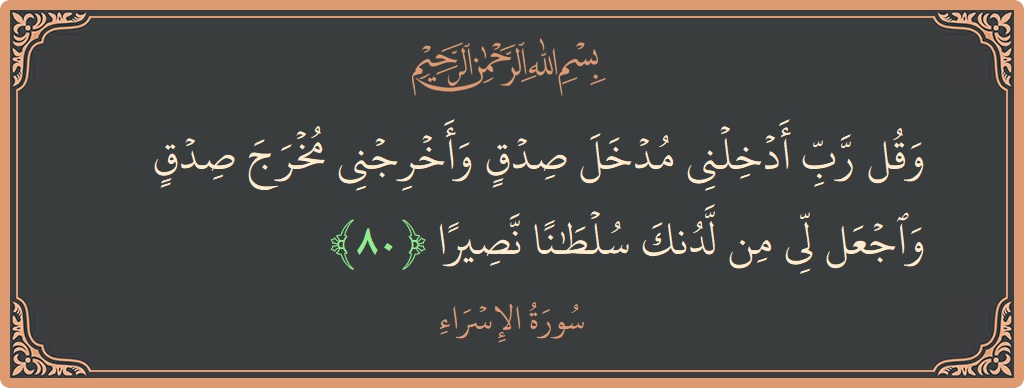
Surah Al-Israa: Verse 80 - وقل رب أدخلني مدخل صدق... - English
Tafsir of Verse 80, Surah Al-Israa
English Translation
And say, "My Lord, cause me to enter a sound entrance and to exit a sound exit and grant me from Yourself a supporting authority."English Transliteration
Waqul rabbi adkhilnee mudkhala sidqin waakhrijnee mukhraja sidqin waijAAal lee min ladunka sultanan naseeranTafsir of Verse 80
It has been reported in al-Jami` of Tirmidhi from Sayyidna ` Abdullah ibn ` Abbas ؓ that the Holy Prophet ﷺ was in Makkah al-Mu` azzamah. Then, he was commanded to migrate to Madinah. Thereupon, this verse was revealed: وَقُل رَّبِّ أَدْخِلْنِي مُدْخَلَ صِدْقٍ وَأَخْرِجْنِي مُخْرَجَ صِدْقٍ (And say, "0 my Lord, make me enter a rightful entrance and make me exit a rightful exit - so). Here, the word: مُدخَل (mudkhal) and مُخرَج (mukhraj) meaning the place of entry and the place of exit are اِسمَ ظرف (ism-al-zarf: the noun of place and time). The addition of the attribute (na't) of صِدق :sidq (translated as rightful) releases the sense of such entry and exit being totally true to the will and pleasure of Allah and in the best of attending circumstances, because the word: صِدق to (sidq) is also used in the Arabic language for every such act as is correct and better both outwardly and inwardly. The words: قَدَمَ صِدْقٍ (Yunus 10:2), لِسَانَ صِدْقٍ (ash-Shu` ara 26:84) and مَقْعَدِ صِدْقٍ (al-Qamar 54:55) have been used in the Holy Qur'an in that very sense.
'Entrance' means 'Madinah' and the place of exit denotes 'Makkah.' The sense takes the form of a prayer: 0 Allah, may my entry into Madinah turn out to be good and smooth, without having to face anything unpleasant and unwelcome on arrival there. And may my exit from Makkah be good and smooth, without being entangled in love of country and home.' There are other exegetic statements too which explain this verse. But, this particular explanation has been reported from Hasan al-Basri (رح) and Qatadah. Ibn Kathir calls it 'the most sound statement.' Ibn Jarir too has gone by it. As for the order, it required that the 'exit' should have been mentioned first while the 'entrance,' later. But, the precedence of 'entrance' and the succession of 'exit' is there, perhaps, to indicate that the exit from Makkah had no purpose of its own, in fact, parting from the Baytullah was extremely shocking. But, there was a purpose - to look for peace, for Islam and Muslims - something that could be hoped for through the entry in Madinah. Therefore, the objective to be achieved was made to come first.
A prayer for important objectives
At the time of his migration to Madinah, Allah Ta’ ala asked the Holy Prophet ﷺ to make this dua' which pleaded with Him that his exit from Makkah and then the arrival in Madinah should both be good and smooth in all possible ways. It was the outcome of this prayer that, though he was within the striking range of the pursuing disbelievers at the time of Hijrah, yet Allah Ta’ ala shielded him at every step and finally made Madinah al-Tayyibah good and promising for him and for all Muslims, both outwardly and inwardly. Therefore, some ` Ulama' have said that every Muslim should remember to make this prayer at the beginning of all objectives they wish to pursue and that this prayer is beneficial for all objectives and purposes. The sentence which complements this very prayer appears next: وَاجْعَل لِّي مِن لَّدُنكَ سُلْطَانًا نَّصِيرًا "and grant me from Your Own a power favoured (by You)." Qatadah, the great tabi` i says: the Holy Prophet ﷺ knew that fulfilling his functional duties as a prophet and working while besieged by enemies were challenges he could not handle personally. Therefore, He prayed to Allah Ta’ ala for help and the power to subdue. The prayer was answered and everyone saw its effects.
The Command to emigrate
Imam Ahmad recorded that Ibn `Abbas said: The Prophet was in Makkah, then he was commanded to emigrate, and Allah revealed the words:
(And say: "My Lord! Let my entry be good, and (likewise) my exit be good. And grant me from You a helping authority.") At-Tirmidhi said, "This is Hasan Sahih." Al-Hasan Al-Basri commented on this Ayah, "When the disbelievers of Makkah conspired to kill the Messenger of Allah , or expel him or imprison him, Allah wanted him to fight the people of Makkah, and commanded him to go to Al-Madinah. What Allah said was:
(And say: "My Lord! Let my entry be good, and (likewise) my exit be good...")
(And say: "My Lord! Let my entry be good...") means, my entry to Al-Madinah.
(and (likewise) my exit be good, ) means, my exit from Makkah. This was also the view of `Abdur-Rahman bin Zayd bin Aslam.
(And grant me from You a helping authority.) Al-Hasan Al-Basri explained this Ayah; "His Lord promised to take away the kingdom and glory of Persia and give it to him, and the kingdom and glory of Byzantium and give it to him." Qatadah said, "The Prophet of Allah knew that that he could not achieve this without authority or power, so he asked for authority to help him support the Book of Allah, the Laws of Allah, the obligations of Allah and to establish the religion of Allah. Authority is a mercy from Allah which He places among His servants, otherwise some of them would attack others, and the strong would consume the weak." Alongside the truth, he also needed power and authority in order to suppress those who opposed and resisted him, hence Allah said:
(Indeed We have sent Our Messengers with clear proofs,) until His saying,
(And We brought forth iron) 57:25
A Threat to the Disbelievers of the Quraysh
(And say: "Truth has come and falsehood has vanished...") This is a threat and a warning to the disbelievers of the Quraysh, for there has come to them from Allah the truth of which there can be no doubt and which they have no power to resist. This is what Allah has sent to them of the Qur'an, faith and beneficial knowledge. Their falsehood has perished or vanished and been destroyed, it cannot remain or stand firm in the face of the truth.
Nay, We fling the truth against the falsehood, so it destroys it, and behold, it dis- appears. Al-Bukhari recorded that `Abdullah bin Mas`ud said: The Prophet entered Makkah (at the Con- quest), and around the House (the Ka`bah) were three hundred and sixty idols. He started to strike them with a stick in his hand, saying,
(Truth has come and falsehood has vanished. Surely falsehood is ever bound to vanish.) 17:81
(Truth has come, and falsehood can neither create anything nor resurrect (anything).) 34:49