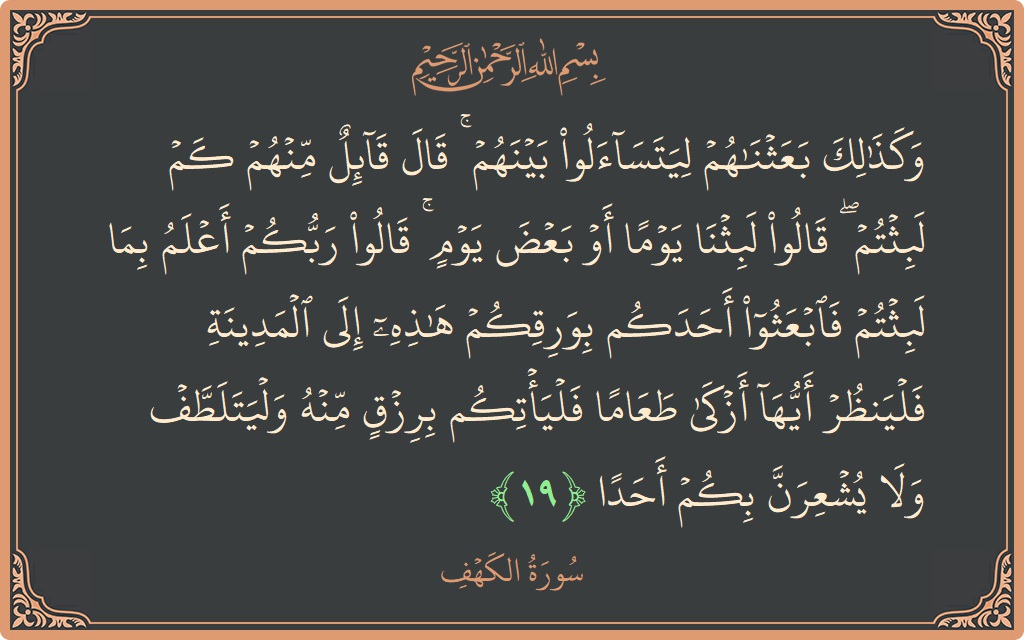
Surah Al-Kahf: Verse 19 - وكذلك بعثناهم ليتساءلوا بينهم ۚ... - English
Tafsir of Verse 19, Surah Al-Kahf
English Translation
And similarly, We awakened them that they might question one another. Said a speaker from among them, "How long have you remained [here]?" They said, "We have remained a day or part of a day." They said, "Your Lord is most knowing of how long you remained. So send one of you with this silver coin of yours to the city and let him look to which is the best of food and bring you provision from it and let him be cautious. And let no one be aware of you.English Transliteration
Wakathalika baAAathnahum liyatasaaloo baynahum qala qailun minhum kam labithtum qaloo labithna yawman aw baAAda yawmin qaloo rabbukum aAAlamu bima labithtum faibAAathoo ahadakum biwariqikum hathihi ila almadeenati falyanthur ayyuha azka taAAaman falyatikum birizqin minhu walyatalattaf wala yushAAiranna bikum ahadanTafsir of Verse 19
Commentary
The word: کَذٰلِک (kadhalik) in the first sentence is for comparison. The purpose at this place is to describe the mutual likeness of two events. One of these is the event of the long sleep of the People of Kahf for an equally long period of time mentioned in the beginning of the story under the verse: فَضَرَبْنَا عَلَىٰ آذَانِهِمْ فِي الْكَهْفِ سِنِينَ عَدَدًا : "So, We veiled their hearing (putting them to sleep) in the Cave for a number of years - 11." The second event relates to the rising of these people from that long drawn sleep - intact, healthy and fit despite the absence of any energy-giving intake - and becoming wide awake. Both are alike in being signs of the power of Allah Ta` ala. For this reason, when 'raising them up' was mentioned in this verse, the word: کَذٰلِک (kadhalik: 'And similarly' ) was used to indicate that the way their sleep was not like the habitual sleep of common people, very similarly, their rising too was distinct from natural habit. Then, as for the next statement after that: لِيَتَسَاءَلُوا ، meaning 'so that they ask each other [ as to how long the sleep was ],' it is not the reason of 'raising them up.' Instead, it is a mention of a usual phenomenon. Therefore, the particle: لام (lam) in: لِيَتَسَاءَلُوا (liyatasa'alu: so that they ask) has been identified as the lam of ` aqibah (consequence) or sairurah (result) meaning that which naturally follows as a sequel. (Abu Hayyan, al-Qurtubi)
In short, their long sleep was a Divine sign. Similarly, sitting up all awake after hundreds of years - fit and healthy without usual nourishment - was also another perfect Divine sign. And it was also Divinely in-tended that they too should come to know that they have been sleeping through hundreds of years, therefore, it began with questions asked between each other and ended at the incident mentioned in the next verse: وَكَذَٰلِكَ أَعْثَرْنَا (And in this way We made them known - 21). It means that the people of the city knew their secret and, despite the difference in determining the period of their stay, everyone believed that they had been sleeping in the Cave for a long period of time.
Given in: قَالَ قَائِلٌ مِّنْهُمْ (One of them said - 19) is the detail of what was said briefly at the beginning of the story (12) - that they differed about the period of their stay in the Cave and that one of them did say the right thing. According to this detail, one person from among the People of the Cave ventured to pose the question as to how long did they sleep. Then, came the response from some that said, 'a day, or part of a day' - because, these people had entered the Cave in the morning and when they woke up, it was evening. Therefore, they thought, that was the day they had entered the Cave and the duration of their sleep was just about a day. But, some from among these very people realized that, perhaps, this was not the day they had entered the Cave. If so, who knows how many days have gone by? Therefore, they decided to let this particular knowledge about the event rest with Allah. By saying: قَالُوا رَبُّكُمْ أَعْلَمُ بِمَا لَبِثْتُمْ (Your Lord knows best how long you stayed - 19), they dismissed this debate as unnecessary and turned their attention to the need of the hour, that is, to send a man to the city to bring some food from there.
The word: الْمَدِينَةِ (al-madinah) in the phrase: إِلَى الْمَدِينَةِ (ila al-madinah: to the city) proves at least this much that there used to be a big city close to the Cave where they had stayed. In his Tafsir al-Bahr al-Muhit, Abu Hayyan has said that the name of the city at the time the People of Kahf left was Ifsus and now, the name was Tarsus. Al-Qurtubi has said in his Tafsir that during the time idol-worship and ignorance prevailed in this city, its name was Ifsus. But, when the believers of that time, that is, the followers of Sayyidna Masih (علیہ السلام) overtook it, they renamed it as Tarsus.
The word: بِوَرِقِكُمْ with this silver [ coin ] of yours - 19) tells us that these good men had also brought some money with them when they came to the Cave. From here we know that the procurement and management of essential expenditures in life is not contrary to the norms of Zuhd (abstention from worldly desires) and Tawakkul (trust in Allah). (Al-Bahr al-Muhit)
The word: أَزْكَىٰ (azka) in: أَيُّهَا أَزْكَىٰ طَعَامًا (which are the purest - 19) means what is clean and pure. According to the Tafsir of Ibn Jubayr, it denotes Halal food. They were alert to the need for such precaution because at the time they had left the city, people used to slaughter animals in the name of idols and that was what they sold in the market. Therefore, they stressed upon the man going out to bring food only after making sure that it was Halal.
Ruling
This tells us that eating food in any city, bazaar or hotel, where most of the food available is حرام Haram, is not permissible without prior investigation.
Their awakening and sending One of Themselves to buy Food Allah says: `just as We caused them to ...
(How long have you stayed (here)) meaning, `how long have you slept'
(They said: "We have stayed a day or part of a day.") because they entered the cave at the beginning of the day, and they woke up at the end of the day, which is why they then said,
("...or a part of a day." They said: "Your Lord knows best how long you have stayed...") meaning, `Allah knows best about your situation.' It seems that they were not sure about how long they had slept, and Allah knows best. Then they turned their attention to more pressing matters, like their need for food and drink, so they said:
(So send one of you with this silver coin of yours) They had brought with them some Dirhams (silver coins) from their homes, to buy whatever they might need, and they had given some in charity and kept some, so they said:
(So send one of you with this silver coin of yours to the town,) meaning to their city, which they had left. The definite article indicates that they were referring to a known city.
(and let him find out which is the Azka food.) Azka means "purest", as Allah says elsewhere,
(And had it not been for the grace of Allah and His mercy on you, not one of you would ever have been pure Zaka from sins) 24:21 and
(Indeed whosoever purifies himself Tazakka shall achieve success.) 87:14 From the same root also comes the word Zakah, which makes one's wealth good and purifies it.
(And let him be careful) meaning when he goes out buying food and coming back. They were telling him to conceal himself as much as he could,
(and let no man know of you. For, if they come to know of you, they will stone you) means, `if they find out where you are,'
(they will stone you or turn you back to their religion;) They were referring to the followers of Decianus, who they were afraid might find out where they were, and punish them with all kinds of torture until they made them go back to their former religion, or until they died, for if they agreed to go back to their (old) religion, they would never attain success in this world or the Hereafter. So they said:
(and in that case you will never be successful.)