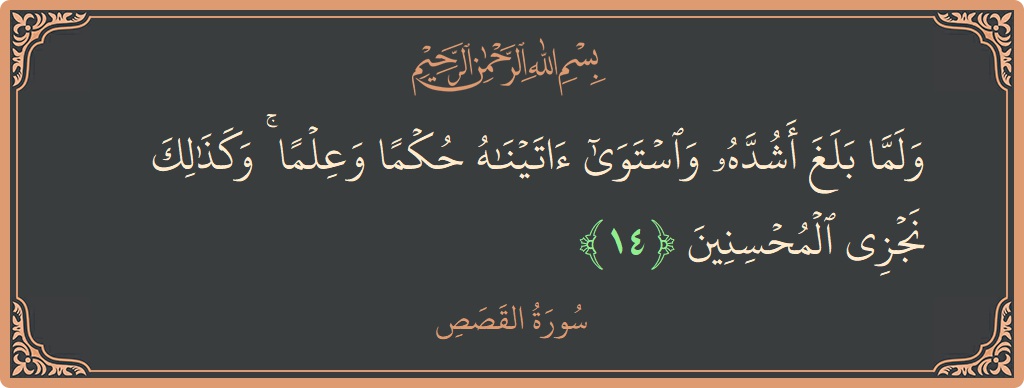
Surah Al-Qasas: Verse 14 - ولما بلغ أشده واستوى آتيناه... - English
Tafsir of Verse 14, Surah Al-Qasas
English Translation
And when he attained his full strength and was [mentally] mature, We bestowed upon him judgement and knowledge. And thus do We reward the doers of good.English Transliteration
Walamma balagha ashuddahu waistawa ataynahu hukman waAAilman wakathalika najzee almuhsineenaTafsir of Verse 14
Commentary
وَلَمَّا بَلَغَ أَشُدَّهُ وَاسْتَوَىٰ (And when he reached his maturity and became perfect - 28:14). The literal meaning of 'ashudd (أَشُدَّ ) is to attain the peak of strength or intensity. For instance a person gradually develops from the position of juvenile weakness to the strength of adulthood. A time comes when he has attained full strength and vigour that he could achieve. That point in life is called أَشُدَّ 'ashudd. In different parts of the world and for different people this point in life varies according to climate, character of the land, race etc. Some people attain it early while others take time. ` Abd Ibn Humaid has reported that Sayyidna Ibn ` Abbas and Mujahid have placed the age of 'ashudd as 33rd year of one's life. This is called the age of perfection or the age of discernment, when the development of body stops after reaching its peak. After this age a period of hold commences, which lasts until the age of forty. This period is mentioned in the verse as اسْتَوَىٰ Istawa (translated above as became perfect). After the age of forty years the decline and weakness sets in. Hence, it can be said that 'ashudd (أَشُدَّ ) of a person starts from the age of 33 years and lasts through 40 years. (Ruh, Qurtubi).
آتَيْنَاهُ حُكْمًا وَعِلْمًا (We gave him wisdom and knowledge - 28:14) The word (حُکُم) lukm (translated above as 'wisdom' ) is used here for prophethood, and the word 'knowledge' refers to the knowledge of divine injunctions.
وَدَخَلَ الْمَدِينَةَ عَلَىٰ حِينِ غَفْلَةٍ مِّنْ أَهْلِهَا (And he entered the city at a time of unawareness of its people - 15). Most commentators have interpreted that the word 'city' is used here for the main city of Egypt. The words 'he entered' indicate that Musa (علیہ السلام) ، had gone away somewhere out of Egypt. Then he entered back at a time when people normally sleep. It is also mentioned in the incident of killing of the 'Qibti' that it was the time when Musa (علیہ السلام) had already announced his prophethood and had started preaching the religion of truth. As a result of his preaching some people had converted, and were known as his disciples. The word مِن شِيعَتِهِ (from his group - 28:15) is a proof of that. All these versions give credence to the narration which is quoted by Ibn Ishaque and Ibn Zaid that when Musa (علیہ السلام) had started talking to the people about the religion of truth, the Pharaoh turned against him and wanted to kill him. But on the appeal of his wife, Sayyidah 'Asiyah, he restrained himself, and instead commanded him to go in exile. After that Sayyidna Musa (علیہ السلام) shifted to some hiding place and would come to the city of Egypt occasionally in hiding. Most commentators are of the opinion that by عَلَىٰ حِينِ غَفْلَةٍ مِّنْ أَهْلِهَا (28:15) the time of afternoon is meant, when people generally take a siesta. (Qurtubi)
فَوَكَزَهُ مُوسَىٰ (So Musa struck him with his fist). Wakaza (وَكَزَ ) means to box فَقَضَىٰ عَلَيْهِ (28:15). The phrase of Qadahu (قَضَاہ) and Qada 'Alaihi (فَقَضَىٰ عَلَيْهِ ) is used when one is totally finished. Hence, here it means that he killed him. (Mazhari)
How Musa killed a Coptic Man
Having described Musa's beginnings, Allah then tells us that when he reached maturity, and was complete in stature, Allah gave him Hukm and religious knowledge. Mujahid said that this means prophethood.
(And thus do We reward the doers of good.) Then Allah describes how Musa reached the status that was decreed for him, that of Prophethood and speaking to Allah, as a direct consequence of killing the Coptic, which was the reason why he left Egypt and went to Madyan. Allah says:
(And he entered the city when its people were unaware.) Ibn Jurayj narrated from `Ata' Al-Khurasani, from Ibn `Abbas, "That was between Maghrib and `Isha'." Ibn Al-Munkadir narrated from `Ata' bin Yasar from Ibn `Abbas, "That was in the middle of the day." This was also the view of Sa`id bin Jubayr, `Ikrimah, As-Suddi and Qatadah.
(and he found there two men fighting,) meaning, hitting one another and struggling with one another.
(one of his party, ) meaning, an Israelite,
(and the other of his foes.) meaning, a Coptic. This was the view of Ibn `Abbas, Qatadah, As-Suddi and Muhammad bin Ishaq. The Israelite man asked Musa, peace be upon him, for help, and Musa took advantage of the fact that people were not paying attention, so he went to the Coptic man and
(so Musa struck him with his fist and he died.) Mujahid said, "This means he punched him with his fist." And then he died.
(He said) refers to Musa.
("This is of Shaytan's doing, verily, he is a plain misleading enemy." He said: "My Lord! Verily, I have wronged myself, so forgive me." Then He forgave him. Verily, He is the Oft-Forgiving, the Most Merciful. He said: "My Lord! For that with which You have favored me,) meaning, `what You have given me of prestige, power and blessings -- '
(I will nevermore be a helper of the criminals!) `those who disbelieve in You and go against Your commands.'