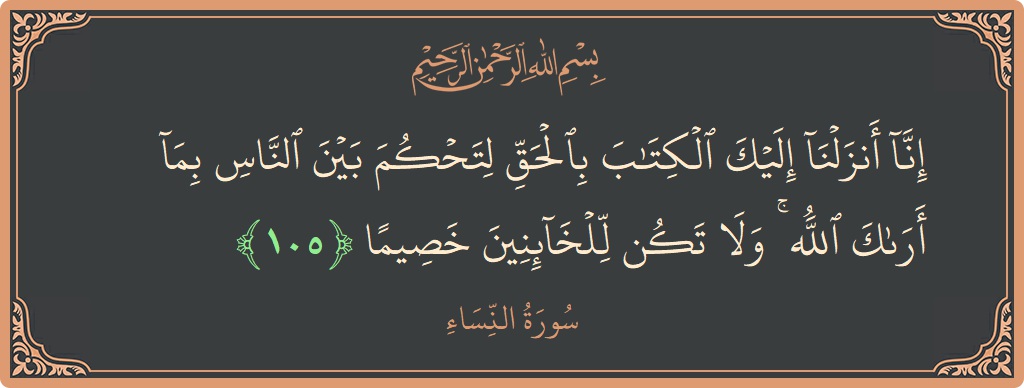
Surah An-Nisaa: Verse 105 - إنا أنزلنا إليك الكتاب بالحق... - English
Tafsir of Verse 105, Surah An-Nisaa
English Translation
Indeed, We have revealed to you, [O Muhammad], the Book in truth so you may judge between the people by that which Allah has shown you. And do not be for the deceitful an advocate.English Transliteration
Inna anzalna ilayka alkitaba bialhaqqi litahkuma bayna alnnasi bima araka Allahu wala takun lilkhaineena khaseemanTafsir of Verse 105
Sequence
While discussing the matters relating to the open disbelievers, the Holy Qur'an has, in some places in the previous verses, referred to the hypocrites and has pointed out that Kufr or disbelief was the common denominator between them. Further on, a particular episode relating to some hypocrites finds mention in the present verses, details of which are being given below.
The Necessity of Referring to What Allah has Revealed for Judgement
Allah says to His Messenger, Muhammad ,
(Surely, We have sent down to you the Book in truth) meaning, it truly came from Allah and its narrations and commandments are true. Allah then said,
(that you might judge between men by that which Allah has shown you,) In the Two Sahihs, it is recorded that Zaynab bint Umm Salamah said that Umm Salamah said that the Messenger of Allah heard the noise of disputing people close to the door of his room, and he went out to them saying,
(Verily, I am only human and I judge based on what I hear. Some of you might be more eloquent in presenting his case than others, so that I judge in his favor. If I judge in one's favor concerning the right of another Muslim, then it is a piece of the Fire. So let one take it or leave it.) Imam Ahmad recorded that Umm Salamah said, "Two men from the Ansar came to the Messenger of Allah with a dispute regarding some old inheritance, but they did not have evidence. The Messenger of Allah said,
(You bring your disputes to me, but I am only human. Some of you might be more persuasive in their arguments than others. I only judge between you according to what I hear. Therefore, whomever I judge in his favor and give him a part of his brother's right, let him not take it, for it is a part of the Fire that I am giving him and it will be tied around his neck on the Day of Resurrection.) The two men cried and each one of them said, `I forfeit my right to my brother.' The Messenger of Allah said,
(Since you said that, then go and divide the inheritance, and try to be just in your division. Then draw lots, and each one of you should forgive his brother thereafter (regardless of who got the best share).)" Allah's statement,
(They may hide (their crimes) from men, but they cannot hide (them) from Allah;) chastises the hypocrites because they hide their evil works from the people so that they will not criticize them. Yet, the hypocrites disclose this evil with Allah, Who has perfect watch over their secrets and knows what is in their hearts. This is why Allah said,
(for He is with them (by His knowledge), when they plot by night in words that He does not approve. And Allah ever encompasses what they do) threatening and warning them. Allah then said,
(Lo! You are those who have argued for them in the life of this world,) meaning, suppose these people gain the verdict from the rulers in their favor in this life, since the rulers judge according to what is apparent to them. However, what will their condition be on the Day of Resurrection before Allah, Who knows the secret and what is even more hidden Who will be his advocate on that Day Verily, none will support them that Day. Hence, Allah's statement,
(or who will then be their defender)