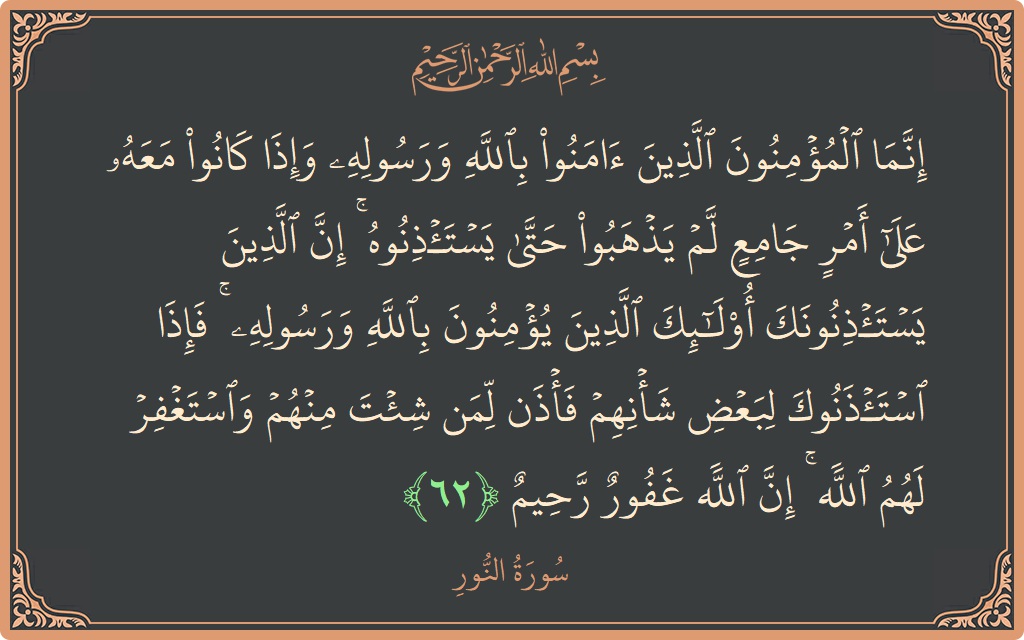
Surah An-Noor: Verse 62 - إنما المؤمنون الذين آمنوا بالله... - English
Tafsir of Verse 62, Surah An-Noor
English Translation
The believers are only those who believe in Allah and His Messenger and, when they are [meeting] with him for a matter of common interest, do not depart until they have asked his permission. Indeed, those who ask your permission, [O Muhammad] - those are the ones who believe in Allah and His Messenger. So when they ask your permission for something of their affairs, then give permission to whom you will among them and ask forgiveness for them of Allah. Indeed, Allah is Forgiving and Merciful.English Transliteration
Innama almuminoona allatheena amanoo biAllahi warasoolihi waitha kanoo maAAahu AAala amrin jamiAAin lam yathhaboo hatta yastathinoohu inna allatheena yastathinoonaka olaika allatheena yuminoona biAllahi warasoolihi faitha istathanooka libaAAdi shanihim fathan liman shita minhum waistaghfir lahumu Allaha inna Allaha ghafoorun raheemunTafsir of Verse 62
Commentary
Some etiquettes and injunctions in regard to meetings with the Holy Prophet ﷺ ' in particular, and in the society in general
The above verses contain two injunctions. The first injunction is that when the Holy Prophet ﷺ call people for the meeting in connection with jihad or any other religious matter, the demand of the faith is that all should attend and must not leave the meeting without his permission. If there is an emergency, permission may be sought from the Holy Prophet ﷺ ، who was advised that unless there is special need and requirement, permission may be granted on such requests. In the same connection those hypocrites are condemned who would come to attend the meeting only to fulfill the obligation of faith, but would quietly sneak out under the cover of some other person.
This verse was revealed at the time of the battle of Ahzab, when the Arab disbelievers and other groups joined together and suddenly attacked Madinah. After consultations with the companions, the Holy Prophet ﷺ consented to dig up a trench to defend against the attack. For this reason this battle is also known as 'the battle of trench (Khandaq) '. This battle was fought in Shawwal 5th Hijra. (Qurtubi)
Baihaqi and Ibn Ishaq have reported that the Holy Prophet ﷺ himself had taken part in the digging of the trench. But the hypocrites used to come late in the first place, and after doing a little bit of work just to show their presence, would sneak away quietly. As against this all the believers were putting in their best, and in case of any need or emergency would take permission from the Holy Prophet ﷺ before leaving the work. At that point this verse was revealed. (Mazhari)
A question and its answer
It appears from this verse that it is forbidden to get up and leave from the presence of the Holy Prophet ﷺ without seeking his permission. But there are several incidents when companions used to leave his meeting when they wished and would not deem it necessary to take his permission. The answer to this point is that the injunction mentioned in the present verse is not an injunction for ordinary meetings, but it is meant for specific gatherings, which the Holy Prophet ﷺ might have called for some need, as was the case at the time of battle of the trench.
The phrase ) عَلَىٰ أَمْرٍ جَامِعٍ (for a collective matter - 62) is itself pointing toward this exclusivity.
What does أَمْرٍ جَامِعٍ (collective matter) mean?
There are different views on this point. The most evident explanation is that this phrase is used for such acts for which the Holy Prophet ﷺ felt necessary to collect the people, as he regarded it important to collect the people for digging the trench on the occasion of battle of Ahzab. (Qurtubi - Mazhari)
Is this injunction exclusive to meetings of the Holy Prophet ﷺ or is general?
Since this injunction is issued for a religious and Islamic need, all the jurists agree that it is not exclusive to meetings of the Holy Prophet ﷺ . The same injunction would apply to any Imam or ruler of the Muslims who is in control of the government, if he called up a meeting. It is obligatory to attend the meetings called up by the rulers and it is not lawful to leave it without permission. (Qurtubi - Mazhari – Bayan ul-Quran)
This is but obvious that this injunction has greater stress and emphasis for meetings called up by the Holy Prophet ﷺ ، and its opposition is open callousness. As for the common meetings and gatherings (not convened by a ruler), acting upon this injunction is surely preferable and commendable from the point of view of Islamic social etiquette. When Muslims are gathered in a meeting for deliberation or action on a collective issue, one should Ie:av ( the meeting only after taking permission from the presiding person.
The second injunction
The second injunction is given in the last verse:
Asking Permission to leave when They are doing something together
This is another matter of etiquette to which Allah has guided His believing servants. Just as He commanded them to seek permission when entering, He also commanded them to seek permission when leaving, especially when they are doing something together with the Messenger , such as the Friday, `Id, or congregational prayers, or a meeting for the purpose of consultation and so on. Allah commanded them not to leave him in these situations until they had asked his permission. If they did this, then they were of the true believers. Then Allah commanded His Messenger to give permission when someone asked for it, if he wanted to. He said:
(give permission to whom you will of them, and ask Allah for their forgiveness.)Abu Dawud reported that Abu Hurayrah said, "The Messenger of Allah said:
(When any of you joins a gathering, let him say Salam, and when he wants to leave, let him say Salam. The former is not more important than the latter.) This was also recorded by At-Tirmidhi and An-Nasa'i; At-Tirmidhi said: "It is a Hasan Hadith."