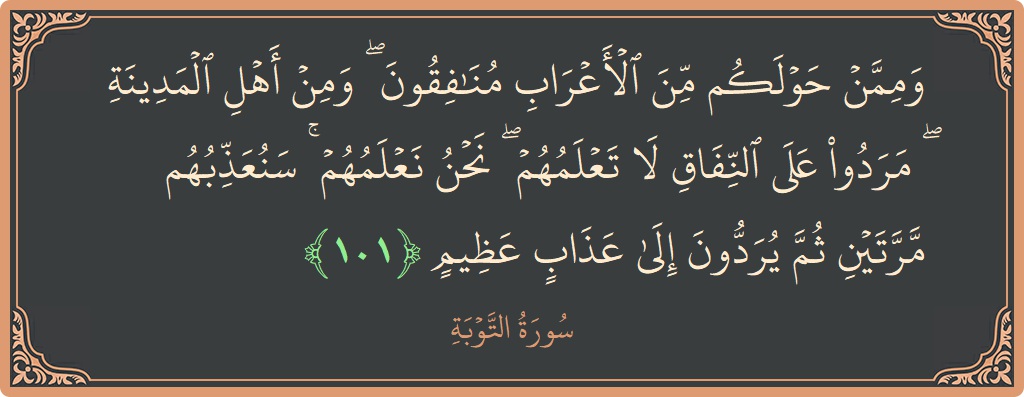
Surah At-Tawba: Verse 101 - وممن حولكم من الأعراب منافقون... - English
Tafsir of Verse 101, Surah At-Tawba
English Translation
And among those around you of the bedouins are hypocrites, and [also] from the people of Madinah. They have become accustomed to hypocrisy. You, [O Muhammad], do not know them, [but] We know them. We will punish them twice [in this world]; then they will be returned to a great punishment.English Transliteration
Wamimman hawlakum mina alaAArabi munafiqoona wamin ahli almadeenati maradoo AAala alnnifaqi la taAAlamuhum nahnu naAAlamuhum sanuAAaththibuhum marratayni thumma yuraddoona ila AAathabin AAatheeminTafsir of Verse 101
Commentary
Mentioned in several previous verses there are hypocrites whose hypocrisy stood exposed through their words and deeds, and the Holy Prophet ﷺ did realize that they were hypocrites. Mentioned in the present verse appearing above there are hypocrites whose hy-pocrisy was so perfect in its camouflage that it remained hidden from the Holy Prophet ﷺ until then. In this verse, two Divine punishments to come much before 'Akhirah upon such diehard hypocrites have been mentioned. In the first instance, right here in this world, they are consumed by the concern to hide their hypocrisy and the fear that it may be exposed. Then, no less a punishment is their being under compulsion to respect and follow Islam and Muslims, at least outwardly, despite their extreme malice and hostility for them. And then, there is the other punishment, the punishment of the grave and the punishment of Barzakh (the post-death - pre-resurrection state) that will reach them well before Qiyamah (doomsday) and 'Akhirah (Hereafter).
Hypocrites among the Bedouins and Residents of Al-Madinah
Allah informs His Messenger, peace be upon him, that among the bedouins around Al-Madinah there are hypocrites and in Al-Madinah itself, those,
(who persist in hypocrisy;) meaning they insisted on hypocrisy and continued in it Allah's statement,
(you know them not, We know them), does not contradict His other statement,
(Had We willed, We could have shown them to you, and you should have known them by their marks; but surely, you will know them by the tone of their speech!)47:30, because the latter Ayah describes them by their characteristics, not that the Messenger knows all those who have doubts and hypocrisy. The Messenger knew that some of those who associated with him from the people of Al-Madinah were hypocrites, and he used to see them day and night but did not know who they were exactly. We mentioned before in the explanation of,
(...and they resolved that (plot) which they were unable to carry out...)9:74 that the Prophet informed Hudhayfah of the names of fourteen or fifteen hypocrites. This knowledge is specific in this case, not that the Messenger of Allah was informed of all their names, and Allah knows best. `Abdur-Razzaq narrated that Ma`mar said that Qatadah commented on this Ayah 9:101, "What is the matter with some people who claim to have knowledge about other people, saying, `So-and-so is in Paradise and so-and-so is in the Fire.' If you ask any of these people about himself, he would say, `I do not know (if I will end up in Paradise or the Fire)!' Verily, you have more knowledge of yourself than other people. You have assumed a job that even the Prophets before you refrained from assuming. Allah's Prophet Nuh said,
(And what knowledge have I of what they used to do)26:112 Allah's Prophet Shu`ayb said,
(That which is left by Allah for you (after giving the rights of the people) is better for you, if you are believers. And I am not a guardian over you)11:86, while Allah said to His Prophet ,
(you know them not, We know them.)" Mujahid said about Allah's statement,
(We shall punish them twice), "By killing and capture." In another narration he said, "By hunger and torment in the grave,
(and thereafter they shall be brought back to a great (horrible) torment.)" `Abdur-Rahman bin Zayd bin Aslam said, "The torment in this life strikes their wealth and offspring," and he recited this Ayah,
(So let not their wealth nor their children amaze you; Allah only wants to punish them with these things in the life of this world.) 9:55 These afflictions torment them, but will bring reward for the believers. As for the torment in the Hereafter, it is in the Fire,
(and thereafter they shall be brought back to a great (horrible) torment.)