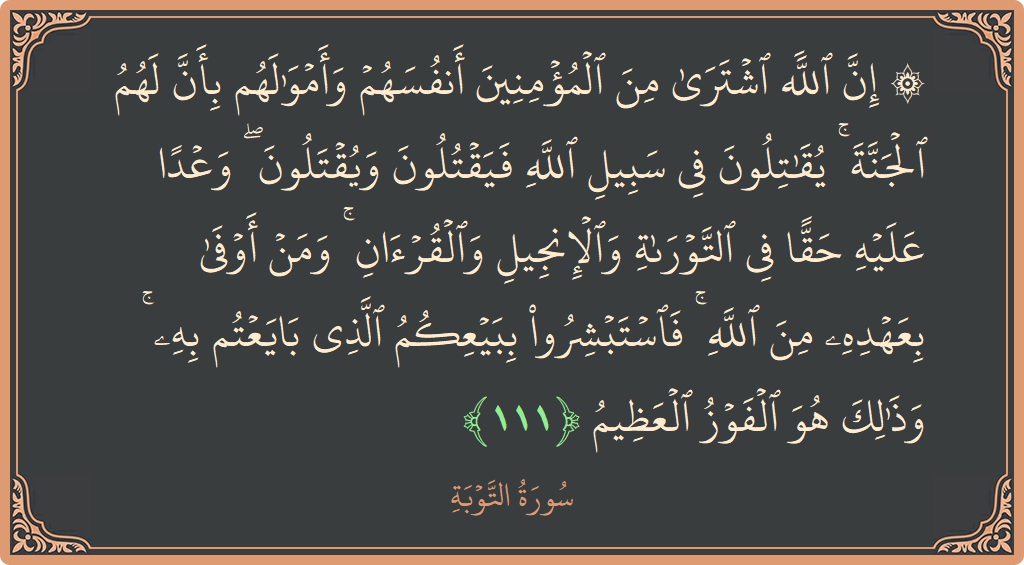
Surah At-Tawba: Verse 111 - ۞ إن الله اشترى من... - English
Tafsir of Verse 111, Surah At-Tawba
English Translation
Indeed, Allah has purchased from the believers their lives and their properties [in exchange] for that they will have Paradise. They fight in the cause of Allah, so they kill and are killed. [It is] a true promise [binding] upon Him in the Torah and the Gospel and the Qur\'an. And who is truer to his covenant than Allah? So rejoice in your transaction which you have contracted. And it is that which is the great attainment.English Transliteration
Inna Allaha ishtara mina almumineena anfusahum waamwalahum bianna lahumu aljannata yuqatiloona fee sabeeli Allahi fayaqtuloona wayuqtaloona waAAdan AAalayhi haqqan fee alttawrati waalinjeeli waalqurani waman awfa biAAahdihi mina Allahi faistabshiroo bibayAAikumu allathee bayaAAtum bihi wathalika huwa alfawzu alAAatheemuTafsir of Verse 111
Commentary
Sequence
Previous verses carried a condemnation of those staying behind without a valid excuse and missing the Jihad. The present verses take up the merit of mujahidin.
The background of revelation
As explained by the majority of commentators, these verses were revealed about the participants of Bai'atul-'Aqabah (the pledge of allegiance to the Holy Prophet ﷺ at al-'Aqabah) which was taken from the Ansar of Madinah before Hijrah in 'Makkah al-Mukarramah. Therefore, despite that the entire Surah is Madani, these verses have been termed as Makki.
'Al-'Aqabah' is part of a mountain. Here, it refers to the 'Aqabah that forms a part of the mountain along the Jamratu al-'Aqabah (the stone pillar of 'Aqabah) in Mina. (In our time, due to the increased number of Hujjaj [ Hajj pilgrims ], this part of the mountain has been leveled to form a smooth surface with the only exception of Jamarah [ the stone pillar ] which still stands there). It is on this 'Aqabah that a pledge of allegiance بیعۃ (bai'ah) was taken from the people of Madinah thrice. The first pledge came in the eleventh year of the Prophet's advent. Six persons embraced Islam, gave the pledge and returned to Madinah. When they arrived there, Islam and the Prophet of Islam became the talk of the town. Next year, it was during the Hajj season that twelve people assembled at the same place. Out of these, five had taken part in the first pledge while the other seven were new. All of them took the pledge. By that time, the number of Muslims in Madinah had increased to more than forty. They requested that someone should be sent to teach Qur'an to them. The Holy Prophet ﷺ sent Sayyidna Mus` ab ibn ` Umair ؓ . He taught Qur'an to Muslims present there as well as conveyed the message of Islam around, as a result of which major groups of people in Madinah entered the fold of Islam.
After that, in the thirteenth year of the Prophet's advent, seventy men and women assembled at the same place. This is the third Bai'atu al-'Aqabah - and the last. Generally, when reference is made to Bai'atu al-'Aqabah, it means this very Bai'ah (pledge of allegiance). This pledge made it binding on participants that they would uphold the basic beliefs (` aqa'id عقَایٔد ) and deeds (a` mal اَعمَال ) of Islam, and would particularly be ready to take part in Jihad against the disbelievers, and protect and support the Holy Prophet ﷺ when he migrates and reaches Madinah. In this connection, Sayyidna ` Abdullah ibn Rawahah ؓ submitted, ` ya rasulallah, a compact is being made at this time. If there are any conditions regarding your Lord or regarding yourself, let these be mentioned there clearly.' He said, ` As for Allah Ta` ala, I lay down the condition that all of you shall worship Him - and worship none but Him. As for myself, the condition is that you shall protect me as you protect your own lives, wealth, property and children.' They asked, ` if we fulfill these two conditions, what shall we get in return?' He said, ` you will get Jannah جَنَّت .' All in delight, they said, ` we are pleased with this deal, so pleased that we shall never request on our own that it be cancelled nor shall we like it to be cancelled.
At this place, since the pledge took the apparent form of a transaction of give and take, this verse (111) was revealed in the terminology of a business deal: إِنَّ اللَّـهَ اشْتَرَىٰ مِنَ الْمُؤْمِنِينَ أَنفُسَهُمْ وَأَمْوَالَهُم بِأَنَّ لَهُمُ الْجَنَّةَ. (Surely, Allah has bought their lives and their wealth from the believers, against which Paradise shall be for them). After hearing this verse, Sayyidna Bara' ibn Ma` rur, Abu al-Haitham and As'ad ؓ عنہم were the first ones who placed their hands on the blessed hand of the Holy Prophet ﷺ . They were promising in effect that they were readily agreeable to this deal and they would protect the Holy Prophet ﷺ as they protected their family and would stand by him to face any challenge, even if it came from the combined forces of the blacks and whites on this Earth.
This is the very first verse of Jihad
Injunctions of Jihad did not exist during the early Makkah period. This is first verse about fighting and killing which was revealed in Makkah al-Mukarramah itself, though its implementation began after Hijrah. After that, came another verse: (Permission [ to fight ] has been given to those who are being fought against - al-Hajj 22:39). When this Bai'atu al-'Aqabah (pledge of 'Aqabah) was concluded in secret from the disbelievers of Makkah, the Holy Prophet ﷺ ordered his noble Companions to migrate from Makkah to Madi-nah. Groups of them started migrating gradually. The Holy Prophet ﷺ remained behind waiting for the permission from Allah Ta` ala. When Sayyidna Abu Bakr ؓ decided to migrate, he held him back so that he could accompany him. (This whole event has been described in Tafsir Mazharl with relevant references)
We can now move to the second sentence of the verse (111): يُقَاتِلُونَ فِي سَبِيلِ اللَّـهِ فَيَقْتُلُونَ وَيُقْتَلُونَ ۖ وَعْدًا عَلَيْهِ حَقًّا فِي التَّوْرَاةِ وَالْإِنجِيلِ وَالْقُرْآنِ (They fight in the way of Allah, and kill and are killed ... a promise on His part which is true (as made) in the Torah and the Injil and the Qur'an). This verse tells us that fighting in the way of Allah was a commandment also revealed for past communities in their Scriptures. As for the popular assumption that there is no injunction of Jihad in the Injil, it is possible that, as part of the changes made by people who came later, the injunctions of Jihad were expunged. Allah knows best.
At the end of the verse (111), it was said: فَاسْتَبْشِرُوا ِبَيْعِكُمُ (So, rejoice in the deal you have made). The agreement arrived at with the Holy Prophet ﷺ in this event of the Bai'atu al-'Aqabah had, on the surface, turned into a sort of buying and selling deal. Therefore, it was expressed through the word: شراء (Allah has bought) at the beginning of the verse. In the present sentence, Muslims were told that they had struck a good deal which will bring blessings for them. The reason was that they had tendered their life and wealth that were mortal while that which they received in return was eternal. If we come to think about it, we would realize that wealth was the only thing they spent out. As for life, that is, the essential spirit, that will remain even after death, and remain forever. And if we were to look deeper into the reality of wealth, that too happens to be nothing but the gift of Allah Almighty. When born, human beings visit the world empty-handed. It was He who made them own everything around them and it was He who made His own gift the price of eternal blessings and gave them Paradise. Therefore, Sayyidna ` Umar ؓ said, ` this is a strange deal where the commodity and the price have both been given to you!'
The sage, Hasan al-Basri (رح) said, ` Behold, what a profitable business is this that Allah has thrown open to every believer!' And he also said, ‘It is Allah who has blessed you with wealth and property. Spend a little out of it and buy Paradise.' (Mazhari)
Allah has purchased the Souls and Wealth of the Mujahidin in Return for Paradise
Allah states that He has compensated His believing servants for their lives and wealth -- if they give them up in His cause -- with Paradise. This demonstrates Allah's favor, generosity and bounty, for He has accepted the good that He already owns and bestowed, as a price from His faithful servants. Al-Hasan Al-Basri and Qatadah commented, "By Allah! Allah has purchased them and raised their worth." Shimr bin `Atiyyah said, "There is not a Muslim but has on his neck a sale that he must conduct with Allah; he either fulfills its terms or dies without doing that." He then recited this Ayah. This is why those who fight in the cause of Allah are said to have conducted the sale with Allah, meaning, accepted and fulfilled his covenant. Allah's statement,
(They fight in Allah's cause, so they kill and are killed.) indicates that whether they were killed or they kill the enemy, or both, then Paradise will be theirs. The Two Sahihs recorded the Hadith,
(Allah has made a promise to the person who goes out (to fight) in His cause; `And nothing compels him to do so except Jihad = in My Cause and belief in My Messengers. ' He will either be admitted to Paradise if he dies, or compensated by Allah, either with a reward or booty if He returns him to the home which he departed from.) Allah's statement,
(It is a promise in truth which is binding on Him in the Tawrah and the Injil and the Qur'an.) affirms this promise and informs us that Allah has decreed this for His Most Honorable Self, and revealed it to His Messengers in His Glorious Books, the Tawrah that He sent down to Musa, the Injil that He sent down to `Isa, and the Qur'an that was sent down to Muhammad, may Allah's peace and blessings be on them all. Allah said next,
(And who is truer to his covenant than Allah) affirming that He never breaks a promise. Allah said in similar statements,
(And who is truer in statement than Allah)4:87, and,
(And whose words can be truer than those of Allah)4:122. Allah said next,
(Then rejoice in the bargain which you have concluded. That is the supreme success.), meaning, let those who fulfill the terms of this contract and uphold this covenant receive the good news of great success and everlasting delight.