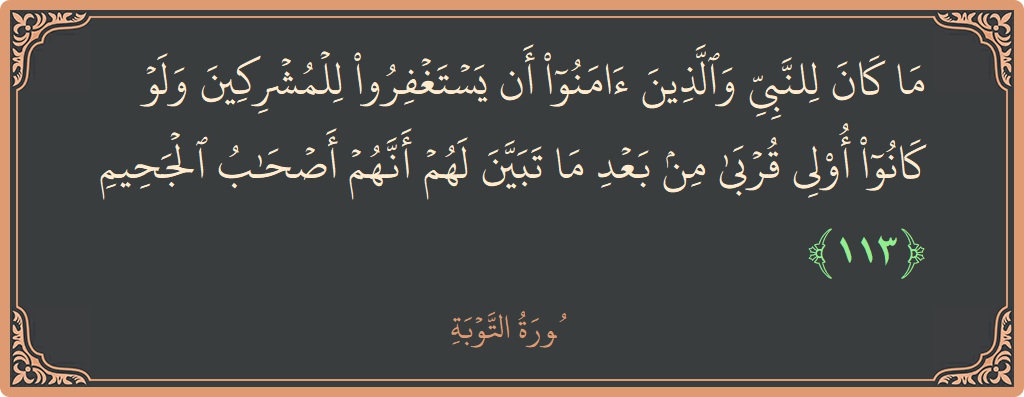
Surah At-Tawba: Verse 113 - ما كان للنبي والذين آمنوا... - English
Tafsir of Verse 113, Surah At-Tawba
English Translation
It is not for the Prophet and those who have believed to ask forgiveness for the polytheists, even if they were relatives, after it has become clear to them that they are companions of Hellfire.English Transliteration
Ma kana lilnnabiyyi waallatheena amanoo an yastaghfiroo lilmushrikeena walaw kanoo olee qurba min baAAdi ma tabayyana lahum annahum ashabu aljaheemiTafsir of Verse 113
Commentary
The entire Surah At-Taubah consists of injunctions of absolution and withdrawal from kafirs (disbelievers) and mushriks (those who associate partners with Allah). The Surah opens with the words: بَرَاءَةٌ مِّنَ اللَّـهِ (Here is a withdrawal [ proclaimed ] by Allah) and that is why this Surah is also known as Surah al-Bara'ah. The injunctions appearing earlier relate to withdrawal and severance of relationships with kafirs and mushriks in this worldly life. The same injunction of withdrawal and severance of relationships appears in the present verses, but it relates to the life hereinafter. It makes it impermissible even to pray for the forgiveness of kafirs and mushriks after their death - as it appears in a previous verse (84) where the Holy Prophet ﷺ has been prohibited from offering funeral prayers for hypocrites.
The background of revelation
The event that was the cause or background of the revelation of this ayah has been reported in a narrative appearing in the Sahih of al-Bukhari and Muslim. According to this report, Abu Talib, the uncle of the Holy Prophet ﷺ had not, though, embraced Islam, yet he continued to support and protect the Holy Prophet ﷺ throughout his life. He did not listen to any member of his clan in this matter. The Holy Prophet ﷺ too was concerned about him. He wished that his uncle would somehow recite the Kalimah and embrace Islam. He would thus be able to intercede on his behalf and he could have his deliverance from the punishment of Jahannam. When Abu Talib was suffering from his last sickness and death became certain, the Holy Prophet ﷺ was worried. He wished if his uncle were to recite the Kalimah even now, things might work for him. He came close to him in that state of anxiety - but, Abu Jahl and ` Abdullah ibn Umayyah (disbelieving diehards) were already there. He said, ` my uncle, recite the Kalimah: لا إلہ إلا اللہ (La ilaha illallah). I shall try to seek forgiveness for you.' But, Abu Jahl interrupted, ` would you forsake the faith of ` Abd al-Muttalib (father of Abu Talib)?' The Holy Prophet ﷺ repeated what he had said several times. But, every time, Abu Jahl would say the same thing he had said before - until the last words spoken by Abu Talib were, ` I am on the faith of ` Abd al-Muttalib.' It was in this very condition that he died. Then, the Holy Prophet ﷺ swore that he would continue seeking forgiveness for him until he was prohibited from it. Thereupon, this verse of prohibition was revealed where the Holy Prophet ﷺ and all Muslims were prohibited from praying for the forgiveness of kafirs and mushriks - even if they were close relatives.
The Prohibition of supplicating for Polytheists
Imam Ahmad recorded that Ibn Al-Musayyib said that his father Al-Musayyib said, "When Abu Talib was dying, the Prophet went to him and found Abu Jahl and `Abdullah bin Abi Umayyah present. The Prophet said,
(O uncle! Say, `La ilaha illa-llah,' a word concerning which I will plea for you with Allah, the Exalted and Most Honored.) Abu Jahl and `Abdullah bin Abi Umayyah said, `O Abu Talib! Would you leave the religion of Abdul-Muttalib' Abu Talib said, `Rather, I will remain on the religion of Abdul-Muttalib.' The Prophet said,
(I will invoke Allah for forgiveness for you, as long as I am not prohibited from doing so.) This verse was revealed,
(It is not (proper) for the Prophet and those who believe to ask Allah's forgiveness for the Mushrikin, even though they be of kin, after it has become clear to them that they are the dwellers of the Fire.) Concerning Abu Talib, this Ayah was revealed,
(Verily, you guide not whom you like, but Allah guides whom He wills) 28:56." This Hadith is recorded in the Two Sahihs. Ibn Jarir recorded that Sulayman bin Buraydah said that his father said, "When the Prophet came to Makkah, he went to a grave, sat next to it, started talking and then stood up with tears in his eyes. We said, `O Allah's Messenger! We saw what you did.' He said,
(I asked my Lord for permission to visit the grave of my mother and He gave me permission. I asked for His permission to invoke Him for forgiveness for her, but He did not give me permission.) We never saw him more tearful than on that day."' Al-`Awfi narrated from Ibn `Abbas about Allah's statement,
(It is not (proper) for the Prophet and those who believe to ask Allah's forgiveness for the Mushrikin) "The Prophet wanted to invoke Allah for forgiveness for his mother, but Allah did not allow him. The Prophet said,
(Ibrahim, Allah's Khalil, invoked Allah for his father.) Allah revealed,
(And Ibrahim's invoking (of Allah) for his father's forgiveness was only because of a promise he Ibrahim had made to him (his father)). " `Ali bin Abi Talhah narrated that Ibn `Abbas commented on this Ayah, "They used to invoke Allah for them (pagans) until this Ayah was revealed. They then refrained from invoking Allah to forgive the dead among them, but were not stopped from invoking Allah for the living among them until they die. Allah sent this Ayah,
(And Ibrahim's invoking (of Allah) for his father's forgiveness was only...) 9:114." Allah said next,
(But when it became clear to him Ibrahim that he (his father) is an enemy of Allah, he dissociated himself from him) 9:114. Ibn `Abbas commented, "Ibrahim kept asking Allah to forgive his father until he died, when he realized that he died as an enemy to Allah, he disassociated himself from him." In another narration, he said, "When his father died he realized that he died as an enemy of Allah." Similar was said by Mujahid, Ad-Dahhak, Qatadah and several others. `Ubayd bin `Umayr and Sa`id bin Jubayr said, "Ibrahim will disown his father on the Day of Resurrection, but he will meet his father and see dust and fatigue on his face. He will say, `O Ibrahim! I disobeyed you, but today, I will not disobey you.' Ibrahim will say, `O Lord! You promised me that You will not disgrace me on the Day they are resurrected. What more disgrace than witnessing my father being disgraced' He will be told, `Look behind you,' where he will see a bloody hyena -- for his father will have been transformed into that -- and it will be dragged from its feet and thrown in the Fire."' Allah's statement,
(Verily, Ibrahim was Awwah and was forbearing.) means, he invoked Allah always, according to `Abdullah bin Mas`ud. Several narrations report this from Ibn Mas`ud. It was also said that, `Awwah', means, `who invokes Allah with humility', `merciful', `who believes with certainty', `who praises (Allah)', and so forth.