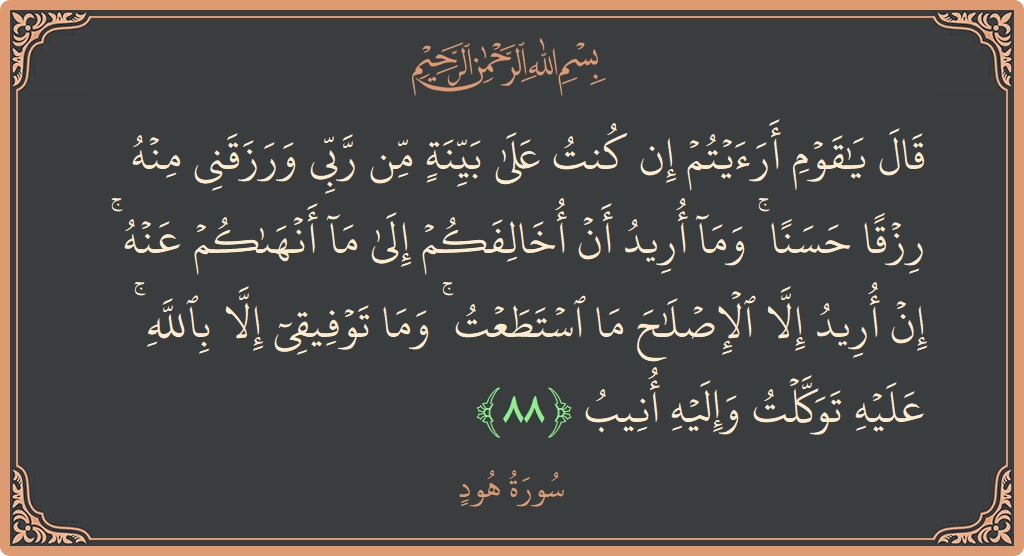
Surah Hud: Verse 88 - قال يا قوم أرأيتم إن... - English
Tafsir of Verse 88, Surah Hud
English Translation
He said, "O my people, have you considered: if I am upon clear evidence from my Lord and He has provided me with a good provision from Him...? And I do not intend to differ from you in that which I have forbidden you; I only intend reform as much as I am able. And my success is not but through Allah. Upon him I have relied, and to Him I return.English Transliteration
Qala ya qawmi araaytum in kuntu AAala bayyinatin min rabbee warazaqanee minhu rizqan hasanan wama oreedu an okhalifakum ila ma anhakum AAanhu in oreedu illa alislaha ma istataAAtu wama tawfeeqee illa biAllahi AAalayhi tawakkaltu wailayhi oneebuTafsir of Verse 88
What Sayyidna Shu'aib (علیہ السلام) had said to his people was good counsel based on earnest fellow feeling. But, his people responded to him with a sarcasm that was biting. However, they had done that to a blessed prophet of Sayyidna Shu'aib's class. He heard their caustic comments, yet turned to them with the same empathy and once again tried to make them see the truth. He said: يَا قَوْمِ أَرَأَيْتُمْ إِن كُنتُ عَلَىٰ بَيِّنَةٍ مِّن رَّبِّي وَرَزَقَنِي مِنْهُ رِزْقًا حَسَنًا (0 my people, tell me, if I am on a clear path from my Lord and He has provided me from Himself with a good provision, [ should I still leave you unguided?] ) Sayyidna Shu'aib (علیہ السلام) was telling his people that he had been blessed by his Lord in that He gave him good provision for his material life and in that He also gave him the light of revelation and spiritual insight. Now, with these wonderful assets in his hands, how could he ever think of becoming like them, willingly embracing error and injustice, and thus failing to bring the truth home to them?
After that, he said: وَمَا أُرِيدُ أَنْ أُخَالِفَكُمْ إِلَىٰ مَا أَنْهَاكُمْ عَنْهُ (and I do not want to do in your absence what I prohibit for you). This tells us that the way a preacher of religion conducts his life has a major role in what he preaches. What a preacher does not himself practice produces no effect on others.
Then, he said: إِنْ أُرِيدُ إِلَّا الْإِصْلَاحَ مَا اسْتَطَعْتُ (I want to do nothing but to set things right as far as I can). And since, this effort too was not by his personal choice and volition, he further said: وَمَا تَوْفِيقِي إِلَّا بِاللَّـهِ ۚ عَلَيْهِ تَوَكَّلْتُ وَإِلَيْهِ أُنِيبُ (And my ability to do things comes from none but Allah. In Him alone I have placed my trust, and to Him alone I turn in humbleness).
Shu`ayb's Refutation of His People
He said to them: Do you see O my people, that if I
(have a clear evidence from my Lord) meaning, upon clear guidance in that which I am calling to.
(and He has given me a good sustenance from Himself.) It has been said that he meant the prophethood. It has also been said that he meant the lawful provisions. It seems that the verse carries both meanings. Ath-Thawri said,
(I wish not, in contradiction to you, to do that which I forbid you.) meaning, `do not forbid you from something and at the same time I contradict my prohibitions in secret behind your backs, doing what I have forbidden.' This is similar to what Qatadah said concerning Allah's statement,
(I wish not, in contradiction to you, to do that which I forbid you.) "He is saying, `I do not forbid you all from something while I do it myself."'
(I only desire reform to the best of my power.) This means, "In that which I command and forbid you, I only want to correct your affair as much as I am able."
(And my guidance cannot come) This means, "In whatever I intend that agrees with the truth."
(except from Allah, in Him I put my trust) This means in all of my affairs.
(and unto Him I repent.) meaning; "I return." This has been said by Mujahid and others.