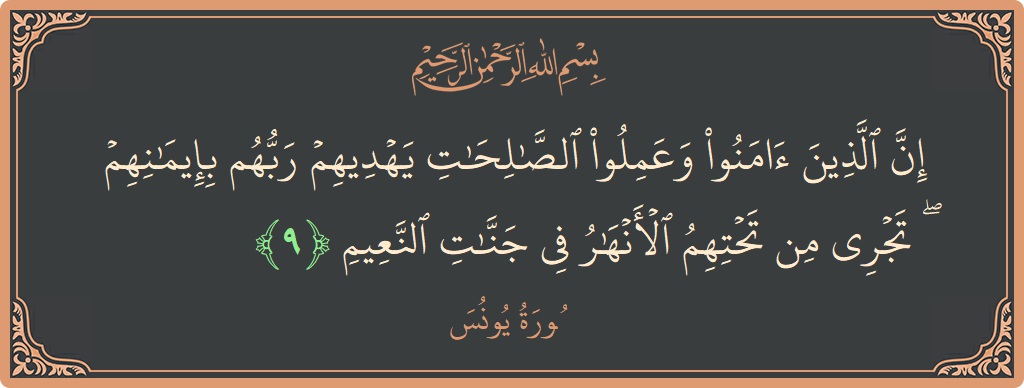
Surah Yunus: Verse 9 - إن الذين آمنوا وعملوا الصالحات... - English
Tafsir of Verse 9, Surah Yunus
English Translation
Indeed, those who have believed and done righteous deeds - their Lord will guide them because of their faith. Beneath them rivers will flow in the Gardens of PleasureEnglish Transliteration
Inna allatheena amanoo waAAamiloo alssalihati yahdeehim rabbuhum bieemanihim tajree min tahtihimu alanharu fee jannati alnnaAAeemiTafsir of Verse 9
Mentioned in the third verse (9) are those fortunate people who pondered over the signs of the most exalted Allah. Thereby, they recognized Him, believed in Him and, by acting in accordance with the dictates of their faith, became duty-bound to say and do what was good and right (al-a` mal as-salihah: good deeds).
The good return and reward made due by the Holy Qur'an for these wonderful people has been mentioned in a particular manner. It was said: يَهْدِيهِمْ رَبُّهُم بِإِيمَانِهِمْ (their Lord will guide them by virtue of their belief), that is, ` take them to their destination, the Jannah [ Paradise ], where rivers shall be flowing in the Gardens of Bliss.'
The well known meaning of the word: ھِدَیَہ (hidayah) used here is to tell or show the way. Then, on occasions, it is also used in the sense of taking someone all the way to the desired destination. At this place, this is the meaning intended. As for the desired destination, it means Jannah that stands clarified by the words appearing later.
It will be recalled that the punishment of the first group was the outcome of their own misdeeds. Here, similar to that, it was said about the reward of the second group (of believers), that they have been blessed with this reward by virtue of their belief. And since, belief has been bracketed with good deeds earlier, therefore, 'Iman or belief mentioned at this place will mean belief that is supported by good deeds (al-a` mal as-salilhah). The return for belief and good deeds is Jannah, the place of unimaginable and unparalleled bliss.
The Good Reward is for the People of Faith and Good Deeds
In these two Ayat, Allah promises the happy blessings for those who believed in Allah and His Messengers. And for those that have complied with what they were commanded to follow. The promise is that He will guide them because of their faith, or it may mean through their faith. As to the first interpretation, the meaning is that Allah will guide them on the Day of Resurrection to the straight path until they pass into Paradise because of their faith in this world. The other meaning is that their faith will assist them on the Day of Resurrection as Mujahid said:
(Their Lord will guide them through their faith) meaning "Their faith will be a light in which they will walk."
(Their way of request therein will be: "Glory to You, O Allah!" And Salam (peace, safety from evil) will be their greetings therein! And the close of their request will be: "All praise is due to Allah, the Lord of all that exists.") meaning this is the condition of the people of Paradise. This is similar to what is found in the following Ayat:
(Their greeting on the Day they shall meet Him will be "Salam Peace!") 33:44,
(No Laghw (dirty, false, evil vain talk) will they hear therein, nor any sinful speech. But only the saying of: Salam! Salam!!") 56:25-26,
((It will be said to them): "Salam" -- a Word from the Lord, Most Merciful.) 36:58,
(And angels shall enter unto them from every gate (saying): "Salamun `Alaykum (peace be upon you)!") 13:23-24 In Allah's statement,
(And the close of their request will be: All praise is due to Allah, the Lord of all that exists.") There is an indication that Allah Almighty is the Praised One always, the Worshipped at all times. This is why He praised Himself at the beginning and the duration of His creation. He also praised Himself in the beginning of His Book and the beginning of its revelation. Allah said:
(All the praises and thanks be to Allah, Who has sent down to His servant the Book (the Qur'an).) 18:1,
(All praise is due to Allah, Who (alone) created the heavens and the earth,) 6:1, and many other citations with this meaning. The Ayah also indicates that Allah is the Praised One in this world and in the Hereafter and in all situations. In a Hadith recorded by Muslim:
(The people of Paradise will be inspired to glorify Allah and praise Him as they instinctively breath.) This will be their nature because of the increasing bounties of Allah upon them. These bounties are repeated and brought back again and increased with no limit or termination. So praise be to Allah for there is no God but He and no Lord save He.