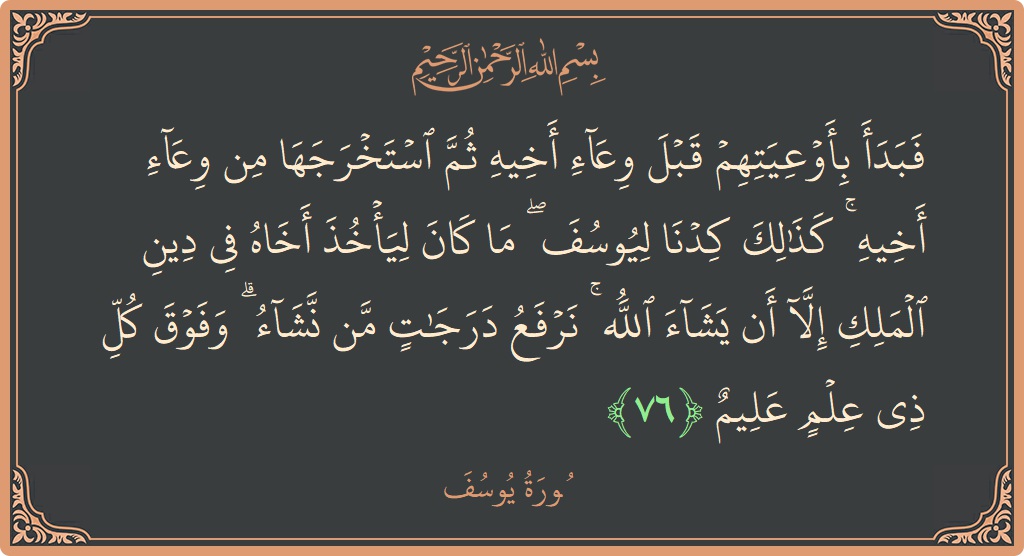
Surah Yusuf: Verse 76 - فبدأ بأوعيتهم قبل وعاء أخيه... - English
Tafsir of Verse 76, Surah Yusuf
English Translation
So he began [the search] with their bags before the bag of his brother; then he extracted it from the bag of his brother. Thus did We plan for Joseph. He could not have taken his brother within the religion of the king except that Allah willed. We raise in degrees whom We will, but over every possessor of knowledge is one [more] knowing.English Transliteration
Fabadaa biawAAiyatihim qabla wiAAai akheehi thumma istakhrajaha min wiAAai akheehi kathalika kidna liyoosufa ma kana liyakhutha akhahu fee deeni almaliki illa an yashaa Allahu narfaAAu darajatin man nashao wafawqa kulli thee AAilmin AAaleemunTafsir of Verse 76
Said in verse 75 was: فَبَدَأَ بِأَوْعِيَتِهِمْ قَبْلَ وِعَاءِ أَخِيهِ , that is, to cover up the real plan, the state officials first searched through the baggage of all brothers. They did not open Benyamin's baggage first lest that causes any doubts.
Then, as said in the first sentence of the next verse (76): ثُمَّ اسْتَخْرَجَهَا مِن وِعَاءِ أَخِيهِ , Benyamin's baggage was opened up last of all and recovered from it was the ` bowl of the king.' At that sight, all brothers were put to shame. They started chiding Benyamin for having disgraced them.
After that, it was said: كَذَٰلِكَ كِدْنَا لِيُوسُفَ ۖ مَا كَانَ لِيَأْخُذَ أَخَاهُ فِي دِينِ الْمَلِكِ إِلَّا أَن يَشَاءَ اللَّـهُ , that is, ` this is how We planned for Yusuf.' He could have not arrested his brother under the Egyptian Imperial Law because, according to their law of theft, there was a corporal punishment for the thief after which he was to be released against the payment of twice the cost of the stolen property. But, here, he had already found out the law of theft operative in the Shari'ah of Sayyidna Ya` qub (علیہ السلام) . According to this law, detaining Benyamin with him became correct and valid. So, also granted through the wisdom and will of Allah Ta’ ala was this wish of Sayyidna Yusuf (علیہ السلام) .
Said in the last sentence of the verse is: نَرْفَعُ دَرَجَاتٍ مَّن نَّشَاءُ ۗ وَفَوْقَ كُلِّ ذِي عِلْمٍ عَلِيمٌ (We elevate in ranks whom so We will [ as, in this event, the ranks of Sayyidna Yusuf (علیہ السلام) were elevated over his brothers ]. And above every man who has knowledge, there is someone more knowledgeable).
It means that Allah has given precedence to some over others in terms of knowledge. Take the highest of the high in knowledge, there is someone more knowledgeable than him. And if there is someone with a knowledge which is superior to the knowledge of the best among the creation of Allah, then, we have the 'Ilm of Allah jalla thana'uh which is the highest of all forever.
Rulings and points of guidance
Some injunctions and rulings deduced from the present verses are given below:
The statement: وَلِمَن جَاءَ بِهِ حِمْلُ بَعِيرٍ (and whoever brings it back shall deserve a camel-load) in verse 72 proves that it is valid to make a general announcement that a particular award or remuneration will be paid to anyone who performs a particular act. This is very much like the cur-rent custom of announcing rewards for the arrest of absconding criminals or for the return of lost properties. Though, this form of transaction does not fall under the juristic definition of Ijarah (hiring), but, in the light of this verse, the justification for this also stands proved. (Qurtubi)
2. The words: وَأَنَا بِهِ زَعِيمٌ (and I stand surety for it) appearing at the end of verse 72 tell us that one person can become the guarantor of financial rights on behalf of another person. The related ruling, according to the majority of Muslim jurists, provides that the creditor has the authority to recover his property from the person legally in debt, or from the guarantor, as he chooses. However, if it is recovered from the guarantor, the guarantor would have the right to recover from the person legally in debt whatever cash or property has been taken from him. (Qurtubi)
3. The sentence: كَذَٰلِكَ كِدْنَا لِيُوسُفَ (This is how We planned for Yusuf) in verse 76 tells us that it is permissible, for a valid reason recognized by Shari’ ah, to change the form of a transaction in a way that it brings a change in its legal status. According to the terminology of the fuqaha' (jurists) it is called 'Hilah Shar` iah' (i.e. a lawful device to avoid a real hardship). However, the condition is that such an action should not cause the invalidation of the injunctions of the Shari’ ah. If so, all such devices are, by the consensus of Muslim jurists, Haram and unlawful - for example, finding an excuse to avoid paying Zakah, or to embark on an unnecessary journey before or during Ramadan simply to seek an excuse for not fasting. This is universally Haram. The hunt for such excuses and devices has brought Divine punishment on some nations, and the Holy Prophet ﷺ has prohibited the use of such stratagems. The entire Muslim Ummah agrees that they are Haram, forbidden and unlawful. Acting upon them does not go on to make whatever is done as permissible. In fact, what falls on the doer is a twofold sin - firstly, that of the original impermissible act; secondly, that of the impermissible device which amounts, in a way, to cheating Allah and His Rasul. That all such hiyal or strategems are impermissible has been proved by Imam Al-Bukhari in his Kitab al Hiyal.