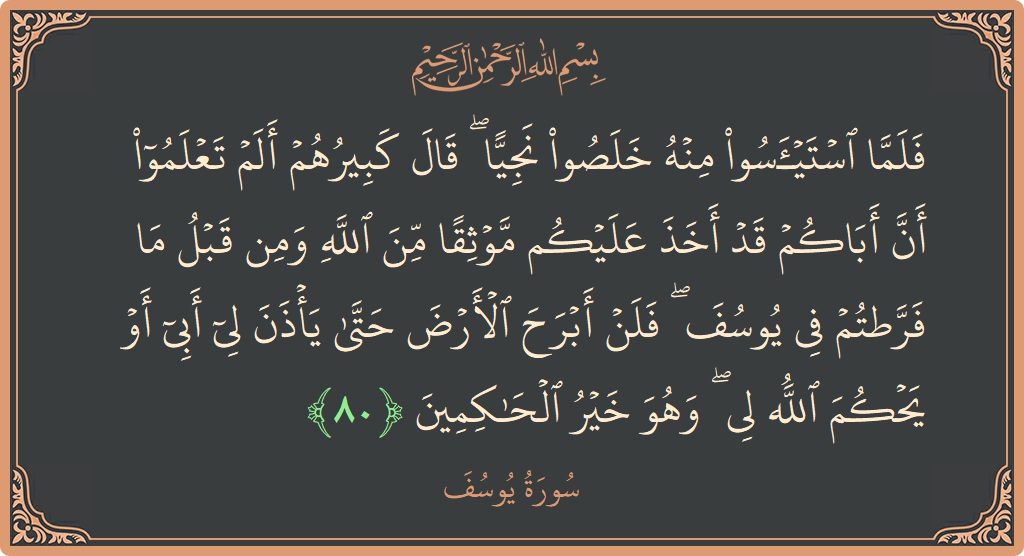
Surah Yusuf: Verse 80 - فلما استيأسوا منه خلصوا نجيا... - English
Tafsir of Verse 80, Surah Yusuf
English Translation
So when they had despaired of him, they secluded themselves in private consultation. The eldest of them said, "Do you not know that your father has taken upon you an oath by Allah and [that] before you failed in [your duty to] Joseph? So I will never leave [this] land until my father permits me or Allah decides for me, and He is the best of judges.English Transliteration
Falamma istayasoo minhu khalasoo najiyyan qala kabeeruhum alam taAAlamoo anna abakum qad akhatha AAalaykum mawthiqan mina Allahi wamin qablu ma farrattum fee yoosufa falan abraha alarda hatta yathana lee abee aw yahkuma Allahu lee wahuwa khayru alhakimeenaTafsir of Verse 80
In verse 80, it was said: فَلَمَّا اسْتَيْأَسُوا مِنْهُ خَلَصُوا نَجِيًّا (So when they lost hope in him, they went aside for consultation).
After that, the primary statement of the oldest brother which begins with the words: قَالَ كَبِيرُهُمْ (The oldest of them said) is continued till the end of verse 80. The statement was: "Do you not know that your father had taken pledge from you in the name of Allah, while you had defaulted earlier in the case of Yusuf (علیہ السلام) . So, I shall never leave this land unless my father permits me (to return) or Allah decides about me. And He is the best of all judges."
This is the statement of the oldest brother. Some commentators identify him as being Yahuda (Judah) - and he was, though not the oldest in age, but was certainly the eldest in knowledge and merit. Other commentators say that he is Ruebel (Rueben) who is the oldest in age and he was the one who had suggested that Sayyidna Yusuf (علیہ السلام) should not be killed. Still others have said that this oldest brother was Sham un who was known to be the eldest in power and rank.
Allah's Prophet Ya`qub receives the Grievous News
Allah's Prophet Ya`qub repeated to his children the same words he said to them when they brought false blood on Yusuf' shirt,
(Nay, but your own selves have beguiled you into something. So patience is most fitting (for me).) Muhammad bin Ishaq said, "When they went back to Ya`qub and told him what happened, he did not believe them and thought that this was a repetition of what they did to Yusuf. So he said,
(Nay, but your own selves have beguiled you into something. So patience is most fitting (for me).) Some said that since this new development came after what they did before to Yusuf, they were given the same judgement to this later incident that was given to them when they did what they did to Yusuf. Therefore, Ya`qub's statement here is befitting,
(Nay, but your own selves have beguiled you into something. So patience is most fitting (for me).) He then begged Allah to bring back his three sons: Yusuf, Binyamin and Rubil to him." Rubil had remained in Egypt awaiting Allah's decision about his case, either his father's permission ordering him to go back home, or to secure the release of his brother in confidence. This is why Ya`qub said,
(May be Allah will bring them (back) all to me. Truly, He! Only He is All-Knowing,), in my distress,
(the All-Wise), in His decisions and the decree and preordainment He appoints. Allah said next,
(And he turned away from them and said: "Alas, my grief for Yusuf!") He turned away from his children and remembered his old grief for Yusuf,
(Alas, my grief for Yusuf!) The new grief, losing Binyamin and Rubil, renewed his old sadness that he kept to himself. `Abdur-Razzaq narrated that Ath-Thawri said that Sufyan Al-`Usfuri said that Sa`id bin Jubayr said, "Only this nation the following of Prophet Muhammad were given Al-Istirja'. Have you not heard the statement of Ya`qub, peace be upon him,
("Alas, my grief for Yusuf !" And he lost his sight because of the sorrow that he was suppressing. )" Ya`qub suppressed his sorrow and did not complain to a created being, according to Qatadah and other scholars. Ad-Dahhak also commented, "Ya`qub was aggrieved, sorrowful and sad." Ya`qub's children felt pity for him and said, while feeling sorrow and compassion,
(By Allah! You will never cease remembering Yusuf), `you will keep remembering Yusuf,
(until you become weak with old age,), until your strength leaves you,'
(or until you be of the dead.) They said, `if you continue like this, we fear for you that you might die of grief,'
(He said: "I only complain of my grief and sorrow to Allah.") When they said these words to him, Ya`qub said,
`(I only complain of my grief and sorrow) for the afflictions that struck me,
(to Allah, ) alone,
(and I know from Allah that which you know not.) I anticipate from Allah each and every type of goodness.' Ibn `Abbas commented on the meaning of,
(and I know from Allah that which you know not.) "The vision that Yusuf saw is truthful and Allah will certainly make it come true."