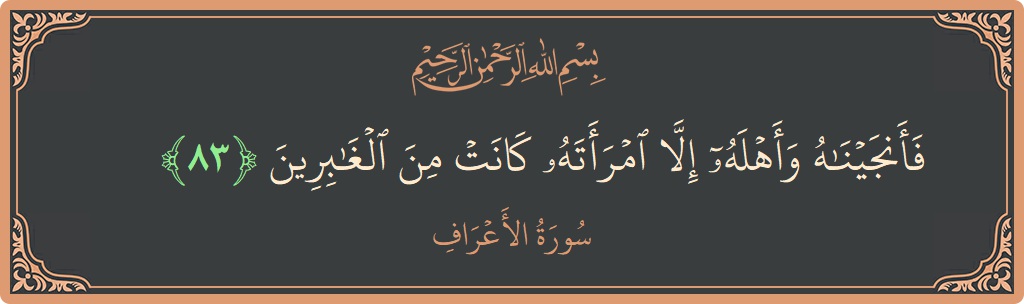
Surah Al-A'raaf: Verse 83 - فأنجيناه وأهله إلا امرأته كانت... - English
Tafsir of Verse 83, Surah Al-A'raaf
English Translation
So We saved him and his family, except for his wife; she was of those who remained [with the evildoers].English Transliteration
Faanjaynahu waahlahu illa imraatahu kanat mina alghabireenaTafsir of Verse 83
Mentioned in the fourth (83) and the fifth (84) verses is the Divine punishment given to the people of Sadum for their crooked and immodest practice. As a consequence, the punishment of Allah Ta` ala descended on the entire people with the exception of Sayyidna Lut (علیہ السلام) and some of his companions who remained safe from the punishment. The words of the Qur'an say: فَأَنجَيْنَاهُ وَأَهْلَهُ (We saved him and his ` ahl' ). Who were these ` ahl?' Some commentators say that included in ` ahl' were two women who had become Muslims. The wife was not. Mentioned in another verse of the Qur'an is: فَمَا وَجَدْنَا فِيهَا غَيْرَ بَيْتٍ مِّنَ الْمُسْلِمِينَ ﴿36﴾ that is, in all those habitations, there was no Muslim home except one - 51:36. This obviously shows that only people from the household of Sayyidna Lut (علیہ السلام) were the ones who were saved from the punishment - and that did not include his wife. Some other commentators say that ahl' is general. It refers to his own family as well as others who had joined him by embracing Islam. To sum up, it can be said that they were a counted few Muslims to save whom Allah Ta` ala ordered Sayyidna Lut (علیہ السلام) to take, except his wife, with him and get out of that habitation late in the night and be sure not to look back, because when they are out of the habitation, the punishment would instantly descend on those in it.
Sayyidna Lut (علیہ السلام) followed the Divine command. He went out of the limits of Sadum with his family and companions late in the night. There are two reports about the wife: (1)-She just did not go with them; (2)-That she did start off with them and walked on for a while, but since she was eager to see the fate of the people she had left behind, quite contrary to the initial Divine command, she was seized by the punishment. This event has been mentioned in the Qur'an at several occasions in varying details. Here, in the fourth verse (83), it has been briefly said that Allah Ta` ala saved Sayyidna Lut (علیہ السلام) and his family and companions from the punishment, but his wife was left with the rest in it. The additional details of how they were saved and how they were asked to leave the habitation late in night and were not to look back appear in other verses.
Allah says, We saved Lut and his family, for only his household believed in him.
Allah said in another Ayah,
(So We brought out from therein the believers. But We found not there any household of the Muslims except one of Lut and his daughters) 51: 35-36. Only his wife (from his family) did not believe, remaining on the religion of her people. She used to conspire with them against Lut and inform them of who came to visit him, using certain signals that they agreed on. This is why when Lut was commanded to leave by night with his family, he was ordered not to inform his wife or take her with him. Some said that she followed them, and when the torment struck her people, she looked back and suffered the same punishment as them. However, it appears that she did not leave the town and that Lut did not tell her that they would depart. So she remained with her people, as apparent from Allah's statement,
(except his wife; she was of the Ghabirin) meaning, of those who remained, or they say: of those who were destroyed, and this is the more obvious explanation. Allah's statement,
(And We rained down on them a rain) is explained by His other statement,
(And rained on them stones of baked clay, in a well-arranged manner one after another. Marked from your Lord; and they are not ever far from the wrongdoers.) 11:82-83. Allah said here,
(Then see what was the end of the criminals. ) This Ayah means: `See, O Muhammad, the end of those who dared to disobey Allah and reject His Messengers.' Imam Ahmad, Abu Dawud, At-Tirmidhi, Ibn Majah, all recorded a Hadith from Ibn `Abbas who said that Allah's Messenger said;
(Whoever is found doing the act of the people of Lut, then kill them; the doer and the one it is done to.)